
Retatrutide vs Tirzepatide: Comparison Guide
Compare Retatrutide and Tirzepatide with an evidence-based guide to help understand their differences and considerations.
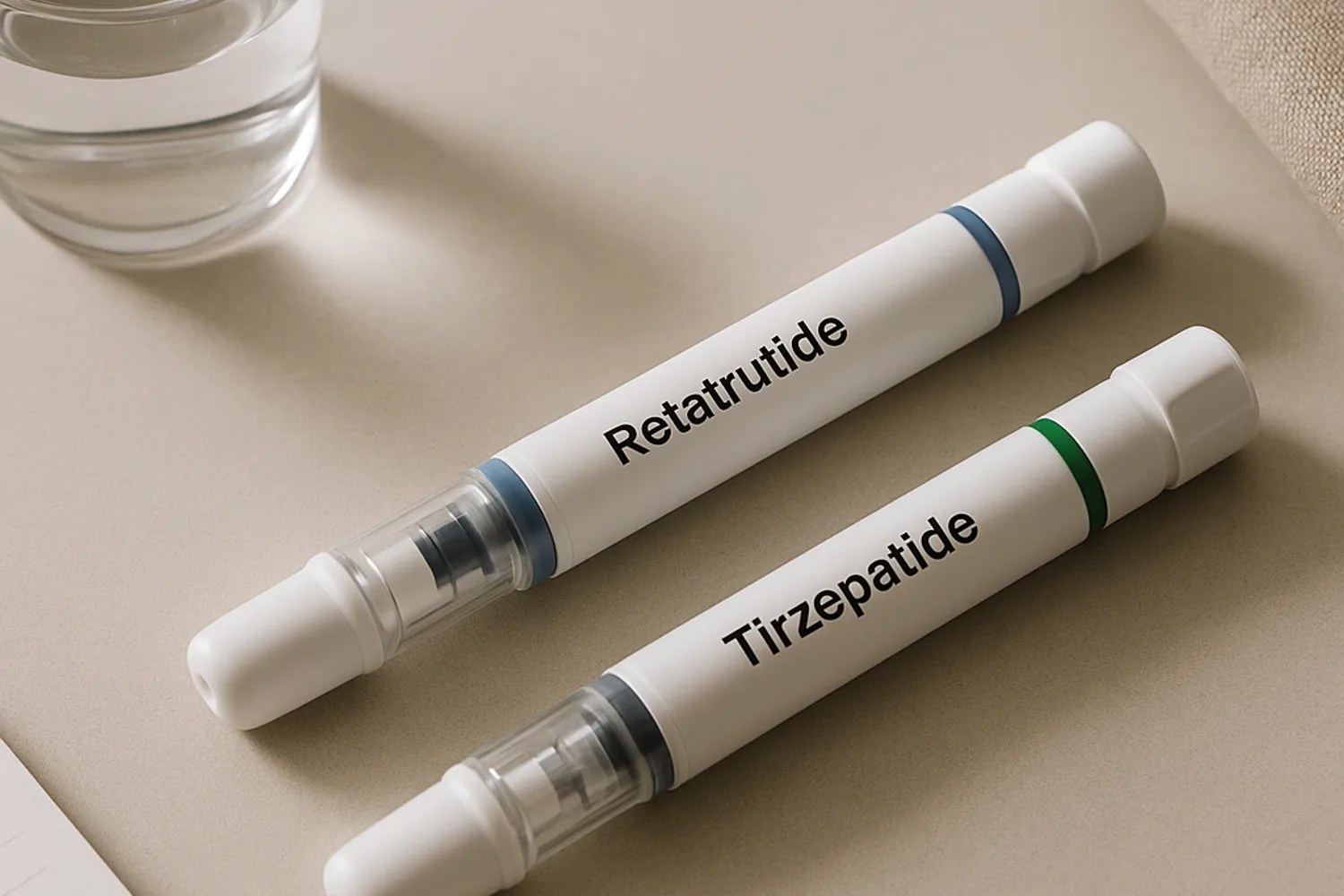
Retatrutide vs Tirzepatide: Comparison Guide
The world of weight management is evolving, with new medications offering hope and effective options for those with obesity. Two names that generate significant discussion are tirzepatide, the active ingredient in Zepbound and Mounjaro, and retatrutide, an investigational medication currently in late-stage clinical trials. While both are part of the same class of drugs, they have important differences.
This guide offers a clear, evidence-aware comparison of retatrutide and tirzepatide to help you understand the current landscape and prepare for informed conversations with your healthcare team. Consult your healthcare provider before starting any medication.
Understanding Tirzepatide (Zepbound and Mounjaro)
Tirzepatide is a well-established medication, approved by the U.S. Food and Drug Administration (FDA) and other global regulatory bodies. It is marketed as Mounjaro for the treatment of type 2 diabetes and as Zepbound for chronic weight management.
How Tirzepatide Works
Tirzepatide is a dual-agonist. This means it mimics and activates the receptors for two different naturally occurring hormones in your body:
- GLP-1 (Glucagon-Like Peptide-1): This hormone helps regulate blood sugar, slows down how quickly your stomach empties, and signals a feeling of fullness to your brain.
- GIP (Glucose-Dependent Insulinotropic Polypeptide): This hormone also helps with blood sugar control and is believed to enhance the effects of GLP-1, contributing to appetite suppression and potential weight loss.
By targeting both of these pathways, tirzepatide provides a powerful, multi-faceted approach to improving metabolic health and supporting weight reduction.
Key Findings from Clinical Trials
The approval of tirzepatide for chronic weight management was based on extensive data from the SURMOUNT clinical trial program. In the landmark SURMOUNT-1 study, participants taking the highest dose of tirzepatide, alongside diet and exercise, achieved an average weight loss of 20.9% of their body weight over 72 weeks.
Common side effects are primarily gastrointestinal and include nausea, diarrhea, constipation, and vomiting. These are typically most pronounced when starting the medication or increasing the dose and often lessen over time. Doctors use a gradual dose-escalation schedule to help manage these effects.
Introducing Retatrutide (The "Triple G" Agonist)
Retatrutide is a newer, investigational medication from the same manufacturer as tirzepatide. It is not yet approved for public use and is currently undergoing Phase 3 clinical trials, the final stage of research required before seeking regulatory approval.
How Retatrutide Works
Retatrutide takes the multi-agonist approach a step further. It is a triple-agonist, targeting the GLP-1 and GIP receptors just like tirzepatide, but adding a third:
- Glucagon (GCG) Receptor: Activating the glucagon receptor is thought to contribute to weight loss by increasing energy expenditure (the number of calories your body burns) and further suppressing appetite.
By engaging three distinct hormonal pathways involved in appetite, satiety, and metabolism, retatrutide represents a potential next step in incretin-based therapies.
Promising Early Trial Results
While we must wait for the full Phase 3 trial results, the data from retatrutide’s Phase 2 study was significant. Published in The New England Journal of Medicine, the trial showed that participants taking the highest dose of retatrutide achieved an average weight loss of 24.2% of their body weight over 48 weeks.
The side effect profile observed in the Phase 2 trial was similar to that of tirzepatide and other GLP-1-based medications, with the most common events being gastrointestinal. As with tirzepatide, a slow dose-titration plan was used to improve tolerability.
Head-to-Head Comparison: Key Differences and Similarities
While these two medications are related, their differences are important for understanding the current and future state of weight management treatments.
Mechanism of Action
- Tirzepatide: A dual-agonist that activates GLP-1 and GIP receptors.
- Retatrutide: A triple-agonist that activates GLP-1, GIP, and Glucagon receptors.
Approval Status
- Tirzepatide: Approved and available by prescription for type 2 diabetes (Mounjaro) and chronic weight management (Zepbound) in many countries.
- Retatrutide: Investigational. It is not yet approved by the FDA or other regulatory agencies and is only available to participants in clinical trials.
Efficacy in Clinical Trials
- Tirzepatide: Has robust, completed Phase 3 trial data demonstrating significant weight loss (averaging up to 20.9% at 72 weeks). This high-quality evidence led to its official approval.
- Retatrutide: Has shown highly promising results in Phase 2 trials, with average weight loss reaching 24.2% at 48 weeks. However, these findings must be confirmed in the larger, more comprehensive Phase 3 trials that are currently underway.
Side Effect Profile
Both medications appear to share a similar side effect profile, which is characteristic of this class of drugs. The most common side effects for both are gastrointestinal, including nausea, diarrhea, and constipation. Both are administered as a once-weekly injection.
What This Means for Your Health Journey
Understanding these medications is about empowerment. It allows you to have more productive and informed conversations with your healthcare provider about your personal health goals.
The Current Landscape vs. The Future
Today, tirzepatide is an established and effective option available to patients who meet the prescribing criteria. It has a proven track record supported by large-scale clinical trials and real-world use.
Retatrutide, on the other hand, represents the future. It is a clear signal of the direction that research is headed—finding more comprehensive ways to target the complex biology of obesity. While its early results are exciting, it is not a clinical option for patients today.
Having an Informed Conversation with Your Doctor
This information is designed to be a starting point for a discussion, not a substitute for professional medical advice. When you speak with your doctor, you can use this knowledge to ask thoughtful questions, such as:
- Based on my health profile, what are the approved treatment options for me?
- What are the potential benefits and risks of the available medications?
- How does medication fit into a larger plan that includes nutrition and physical activity?
Your healthcare provider can assess your individual situation, including your health history and treatment goals, to determine the most appropriate path forward. Consult your healthcare provider before starting any medication.
The development of medications like tirzepatide and retatrutide marks a pivotal moment in medicine, offering powerful new tools to support individuals on their path to better health. As science continues to advance, the options for managing chronic weight conditions will only continue to grow.
Sources
- FDA Approves New Medication for Chronic Weight Management: `https://www.accessdata.fda.gov/drugsatfda_docs/label/2024/217806s003lbl.pdf
- Tirzepatide Once Weekly for the Treatment of Obesity (SURMOUNT-1): `https://pubmed.ncbi.nlm.nih.gov/35658024/
- Retatrutide, a GIP, GLP-1, and Glucagon Receptor Agonist, for People with Obesity (Phase 2): `https://www.nejm.org/doi/full/10.1056/NEJMoa2301972
- Incretin-Based Therapies Overview (StatPearls, NIH): `https://www.ncbi.nlm.nih.gov/books/NBK544311/
- A Study of Retatrutide in Participants With Obesity (TRIUMPH-1): `https://classic.clinicaltrials.gov/ct2/show/NCT06163884
Written by
Dietician / Nutritionist
Health Content Writer
Kriti Agarwal is a Dietician / Nutritionist professional who contributes evidence-informed health and wellness content for WeightEasy.
View profile →Reviewed by
Dietician / Nutritionist, Phd scholar
Senior Medical Reviewer
Nishat Anjum is a Dietician / Nutritionist, Phd scholar professional who reviews WeightEasy health content for medical and editorial accuracy.
View profile →