
How to Track Your GLP-1 Dose Cycle Without Missing Key Patterns
Learn how to track your GLP-1 dose cycle, appetite changes, side effects, and weekly routines so you can spot patterns early and stay consistent.
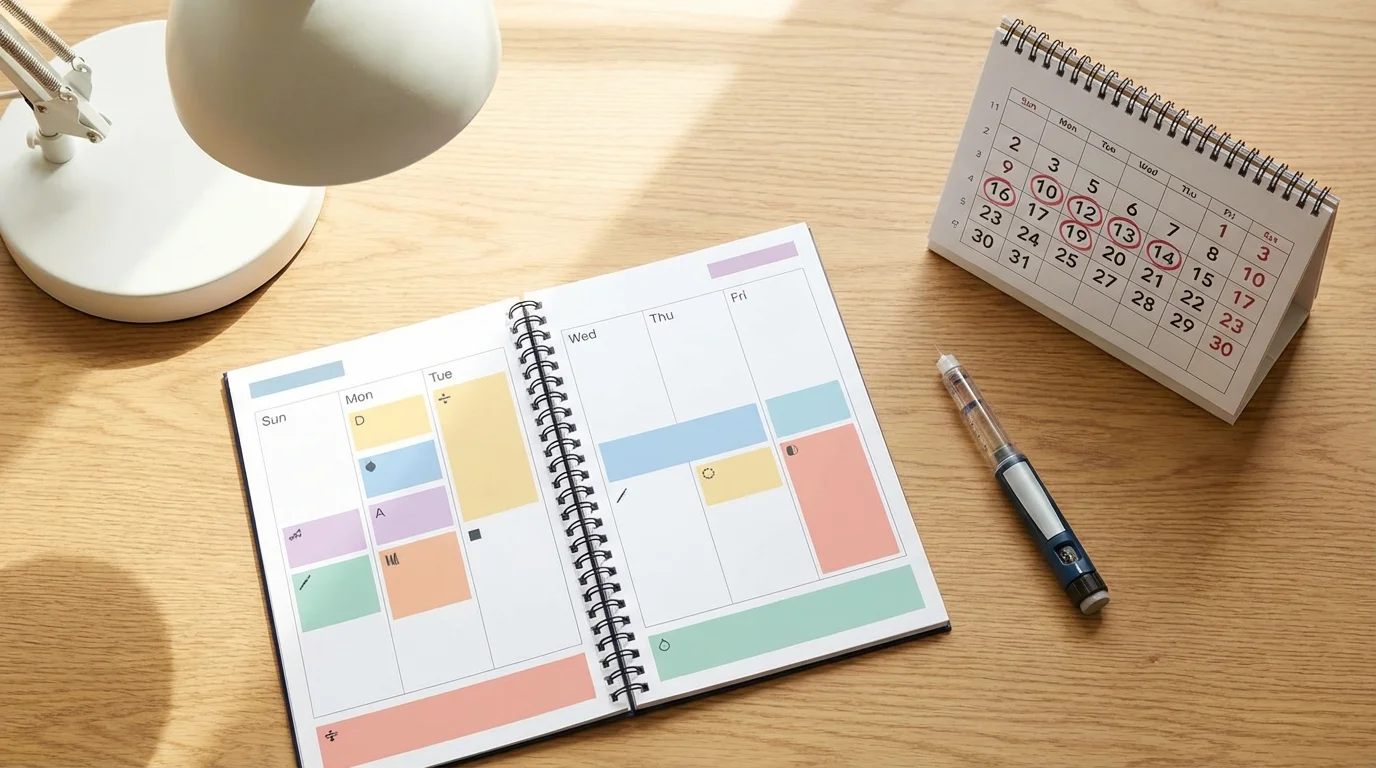
Tracking a GLP-1 journey works better when you treat each week as a cycle rather than a single weigh-in. Most people notice that appetite, energy, cravings, and side effects move up and down depending on where they are in the dose week.
If you only log weight, you miss the context that explains why one week felt smooth and another felt difficult. The better approach is to connect your injection schedule with the rest of your routine — and review everything together at the end of each week.
Why the weekly cycle matters
GLP-1 medications like semaglutide (Ozempic, Wegovy) and tirzepatide (Mounjaro, Zepbound) are once-weekly injections. After each shot, drug levels in your blood rise over 24–72 hours, peak, then gradually decline through the rest of the week before the next dose.
This pharmacokinetic curve has real, predictable effects on your experience:
- Days 1–3: Appetite suppression is typically strongest. Side effects, if any, are most likely in this window.
- Days 4–5: A middle zone. Most people feel controlled hunger and reasonable energy.
- Days 6–7: Drug levels are at their weekly low. Hunger often creeps back. Energy may dip slightly.
When you understand this cycle, a difficult Day 6 does not feel like the medication is failing — it feels like the expected end-of-cycle pattern that resolves after your next injection.
Start with the weekly rhythm
Your first anchor should be the day and time of your injection. Once that is stable, the rest of your tracking becomes easier to interpret.
Track these essentials every week:
- Injection day and time
- Dose amount (especially important during escalation)
- Appetite level: morning, afternoon, and evening on at least 3–4 days
- Any nausea, reflux, constipation, or fatigue and when they appeared
- Daily water intake
- Sleep quality and duration
- Whether meals stayed roughly on track or were significantly disrupted
This does not need to be detailed. A 60-second daily note that captures appetite, hydration, and any symptoms is enough.
The signals that actually explain your week
The goal is not to record everything. The goal is to record the signals that help you make sense of the week.
Appetite timing
Many people feel their strongest appetite control in the first few days after an injection and then notice hunger drifting back later in the week. That pattern matters because it affects planning, not just willpower.
Knowing that Day 6 and Day 7 are likely to bring stronger hunger means you can prepare. Have protein-rich foods ready, plan meals in advance, and do not interpret late-week hunger as a personal failure. It is a pharmacological pattern.
Side-effect timing
It is useful to note when side effects happen, not only whether they happen. A predictable pattern is easier to manage than a vague memory that you felt unwell "at some point."
If nausea always appears 18–24 hours after your injection and resolves by Day 3, that is useful information. You can eat lighter on Day 2, avoid high-fat foods, and plan your social meals for later in the week when you feel better.
If a new symptom appears on Day 5 or 6 — well outside the typical post-injection window — it is likely not the GLP-1 medication causing it, and you can look at other explanations.
Routine consistency
Sleep, hydration, meal timing, and protein intake often explain why two identical doses can feel very different from one week to the next.
A week with poor sleep and low hydration will produce more nausea, more fatigue, and worse appetite control than the same dose in a well-rested, well-hydrated week. Tracking routine variables makes this visible — so you are debugging your week, not questioning your medication.
What to log each day
You do not need a complicated system. These five things take under a minute:
- Appetite rating: Low / Moderate / High (compared to your baseline before GLP-1)
- Water intake: Number of glasses or litres
- Sleep: Hours and rough quality (good / disrupted / poor)
- Symptoms: Any notable side effects and their severity (0–3)
- Meals: One line — on track / smaller than usual / significantly off plan
If you use WeightEasy, you can log all five in a single daily entry connected to your dose schedule and weight trend.
What to review on injection day
Injection day is the natural moment for a weekly review. Before you take your next dose, spend five minutes looking back.
Ask yourself:
- Was appetite control consistent this week or did it break down at a specific point?
- Did any symptoms appear? When? What seemed to trigger them?
- How did hydration and sleep hold up?
- Was there a specific day that felt harder than others? What was different?
- Is this week's pattern similar to last week, or was something different?
Over time, these weekly reviews build a picture that is far more useful than any single data point.
Review the cycle before you change the plan
Before assuming a dose is "not working," look back at the whole week.
This is one of the most common errors people make on GLP-1 therapy. They have a rough Week 6 — maybe related to poor sleep, illness, or a social event that disrupted eating — and conclude the drug is ineffective.
A systematic review of the week often reveals the real explanation:
- Was the shot taken on time? Even a day-late injection shifts the cycle and can produce a rough week.
- Did side effects change food quality or hydration? Nausea on Days 1–2 can lead to eating poorly the rest of the week, which creates a feedback loop.
- Did appetite rebound late in the week? This is a cycle issue, not a drug failure issue.
- Was the routine disrupted by travel, illness, or stress? These are powerful confounders.
That review is more useful than reacting to a single rough day or week.
Tracking during dose escalation
The escalation phase — typically the first 4–5 months for semaglutide, slightly different for tirzepatide — requires more attention than the maintenance phase.
Each time your dose increases:
- Treat the first two weeks as an adjustment window
- Expect side effects to be stronger in that window, then ease off
- Do not judge the long-term effectiveness of a dose during its first two weeks
- Note whether the escalation triggered any new symptoms that were not present at the previous dose
Tracking this carefully means you can tell your doctor exactly when a side effect appeared and whether it is persisting or improving — which directly affects decisions about whether to stay at a dose or slow the escalation.
Building a simple weekly review habit
At the end of each week, review:
- Your dose
- Your average appetite pattern across the cycle
- The biggest side effect, if any, and when it appeared
- One routine habit that helped
- One friction point to address next week
This five-item review takes 10 minutes and pays off enormously during clinician check-ins. Instead of relying on vague memory, you have a documented weekly record.
What good tracking looks like in practice
Here is an example of what a useful weekly summary looks like after 8 weeks on semaglutide:
"Dose: 0.5 mg. Injection: Monday morning. Appetite: strong Days 1–3, normal Days 4–5, noticeably hungry Days 6–7. Nausea: Day 1 afternoon only, mild, resolved without medication. Constipation: Days 4–5, managed with extra water and prunes. Sleep: good all week. Weight: down 0.4 kg."
That note — written in two minutes — is far more useful than "this week was okay I think."
Final takeaway
The most useful GLP-1 tracking is specific enough to reveal patterns and simple enough to repeat. A weekly cycle view gives you that balance. Over time, it becomes easier to tell the difference between a dose issue, a routine issue, and a normal week-to-week fluctuation.
Tracking your GLP-1 dose cycle is not about micromanaging your health. It is about having the information you need to make good decisions — and to give your healthcare provider the context they need to help you.
Consult your healthcare provider before starting, adjusting, or stopping any medication.
Consult your healthcare provider before starting any medication.
Sources
- Ozempic prescribing information: https://www.accessdata.fda.gov/drugsatfda_docs/label/2025/209637s025lbl.pdf
- Wegovy prescribing information: https://www.accessdata.fda.gov/drugsatfda_docs/label/2024/215256s011lbl.pdf
- Mounjaro prescribing information: https://www.accessdata.fda.gov/drugsatfda_docs/label/2025/215866s034lbl.pdf
- Zepbound prescribing information: https://www.accessdata.fda.gov/drugsatfda_docs/label/2024/217806s003lbl.pdf
Related Articles
-
Novo Nordisk. Ozempic (semaglutide) Prescribing Information — pharmacokinetics section
-
Eli Lilly. Zepbound (tirzepatide) Prescribing Information — pharmacokinetics section
-
Davies M, et al. Semaglutide 2.4 mg once a week in adults with overweight or obesity (STEP 1). N Engl J Med. 2021;384:989–1002
-
Jastreboff AM, et al. Tirzepatide Once Weekly for the Treatment of Obesity (SURMOUNT-1). N Engl J Med. 2022;387:205–216
FAQ
How often should I log my GLP-1 routine?
A quick daily check-in plus a more detailed review on injection day usually gives enough context to notice appetite, symptom, and energy patterns.
Should I track only my weight?
No. Weight matters, but dose timing, appetite, side effects, sleep, hydration, and meal consistency usually explain more about how a week actually went.
Why does my appetite come back at the end of the week on GLP-1?
GLP-1 medications have a weekly cycle. Appetite suppression is usually strongest in the first few days after your injection, then gradually eases as the drug level in your body drops before the next dose. This is normal and predictable — tracking it helps you plan meals and manage hunger more effectively.
What should I do if my GLP-1 seems less effective over time?
Before concluding the drug is failing, review the full week: Was the injection on time? Were there disruptions to sleep, meals, or hydration? Did appetite rebound reflect the end-of-cycle pattern rather than a genuine loss of response? If you have ruled these out and weight has plateaued for 12+ weeks at maintenance dose, speak to your doctor about dose adjustment.
What is the best app for tracking GLP-1 injections?
A good tracker should handle dose logging, injection reminders, weekly weight trends, and symptom notes in one place rather than scattering them across separate apps. WeightEasy is built specifically for this — connecting injection logs, appetite notes, and weight trends so you can see the full weekly cycle.
Written by
Dietician / Nutritionist
Health Content Writer
Gantagi shalini is a Dietician / Nutritionist professional who contributes evidence-informed health and wellness content for WeightEasy.
View profile →Reviewed by
Dietician / Nutritionist, Phd scholar
Senior Medical Reviewer
Nishat Anjum is a Dietician / Nutritionist, Phd scholar professional who reviews WeightEasy health content for medical and editorial accuracy.
View profile →