
Travelling with GLP-1: Storage and TSA Tips
Learn essential tips for storing GLP-1 medications like Ozempic and Mounjaro at home and while traveling, including TSA guidelines.
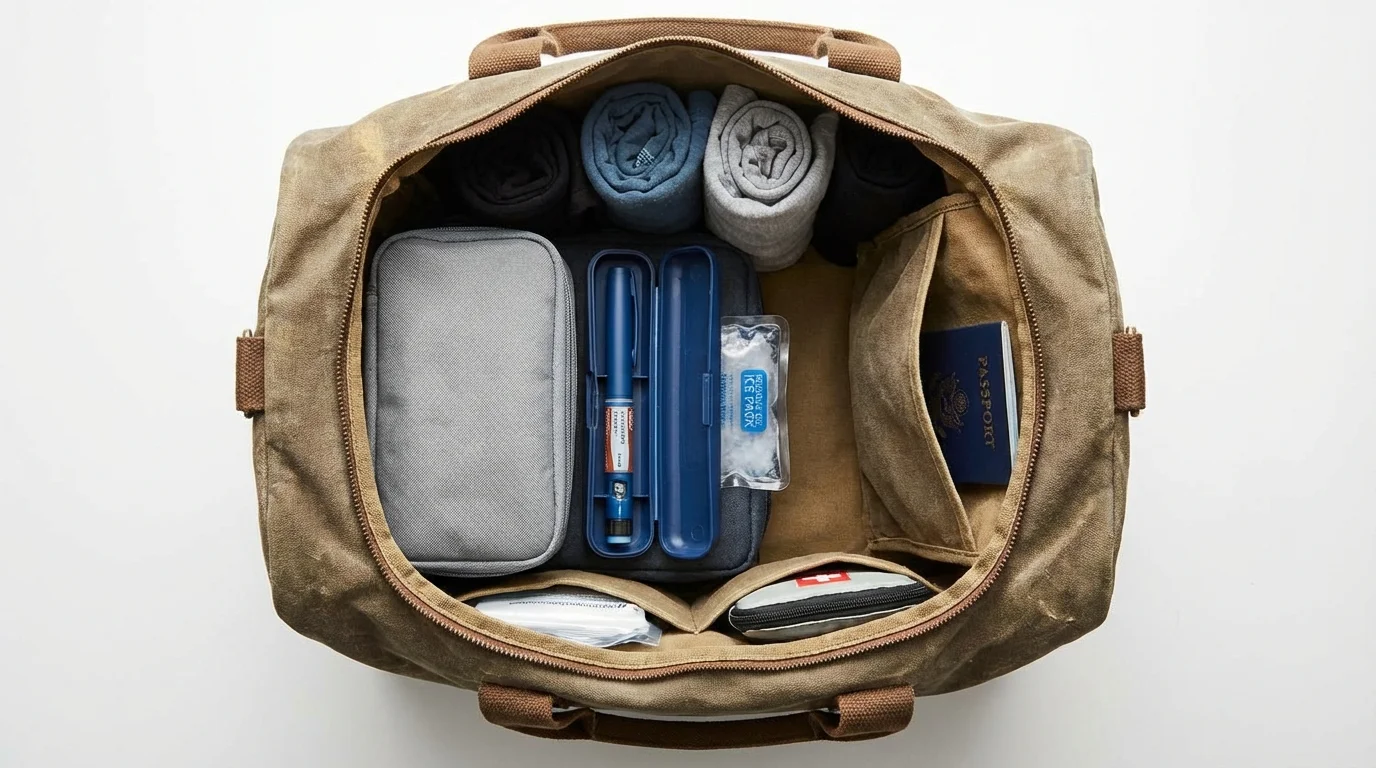
Travelling with GLP-1 medication raises practical questions that do not always have obvious answers, where to store the pen on a long flight, what to do with your dose when you cross time zones, and what happens if your bag gets left in a hot car.
Here is a clear guide to everything you need to know.
Storage at home
Unopened pens (all GLP-1 drugs)
- Store in the refrigerator at 2°C–8°C (36°F–46°F)
- Do not store near the freezer compartment, accidental freezing ruins the medication
- Keep away from direct light
- Never freeze, frozen GLP-1 pens cannot be used and should be discarded
In-use pens (after first injection)
Once a pen has been used for the first time, it can be kept at room temperature. Temperature limits vary by drug:
| Drug | In-use room temp limit | Max days at room temp |
|---|---|---|
| Ozempic (semaglutide) | Up to 30°C (86°F) | 56 days |
| Wegovy (semaglutide) | Up to 30°C (86°F) | 28 days |
| Mounjaro (tirzepatide) | Up to 30°C (86°F) | 21 days |
| Zepbound (tirzepatide) | Up to 30°C (86°F) | 21 days |
| Rybelsus (oral) | Up to 25°C (77°F) | Within bottle expiry |
After the maximum room temperature period, discard the pen even if medication remains.
Flying with GLP-1 medication
In hand luggage vs checked luggage
Always carry medication in your hand luggage. Checked baggage hold temperatures are not controlled, they can drop well below freezing on long flights, which would destroy your pen. Carry-on baggage stays in a climate-controlled cabin.
TSA (US) rules
GLP-1 injection pens are medically necessary medications and are exempt from the standard 100 ml liquid rule in hand luggage.
- You do not need a TSA-specific form
- Carry the original prescription label on the box or pen
- Declare the medication at security screening ("I have injectable medication in my bag")
- Ice packs or cooling pouches used to keep medication cold may also need to be declared
International travel
Rules vary by country. In most countries, carrying prescription medication with documentation is permitted. The safest approach:
- Carry a letter from your prescribing doctor stating the medication, dose, and that it is medically required
- Carry the original pharmacy packaging with your name on it
- Research specific customs requirements if travelling to countries with strict medication rules
Keeping medication cool while travelling
If you have an opened pen and are travelling in hot weather, or transporting an unopened pen without guaranteed refrigeration:
Frio cooling wallets
These fabric wallets contain crystals that activate when soaked in water. They keep medication at 18–26°C for 45+ hours, no refrigeration or power required. Compact, TSA-friendly, and widely available.
Small travel coolers (with ice packs)
For longer trips, a dedicated small medication cooler with a reusable ice pack works well. Make sure the pen does not touch ice directly, direct contact can cause localised freezing.
Hotel refrigerators
Most hotel rooms have small refrigerators. Ask at the front desk if yours does not, hotels often have secure refrigeration available for guests with medical needs.
What to do if your pen gets too warm
If you suspect your pen has been stored above 30°C (86°F) for more than a short period:
- Do not use it
- Check the prescribing information for your specific drug
- Contact your pharmacy, they may be able to advise whether the pen is still usable based on how long and how warm it got
- When in doubt, get a replacement pen rather than risk an ineffective or degraded dose
Signs a pen may be compromised: cloudiness in a normally clear solution, particles, or unusual colour.
Managing your injection schedule across time zones
For weekly injections, the exact time of day matters less than the day of the week.
If you cross multiple time zones:
- Keep your injection day consistent (e.g., always Wednesday) rather than trying to maintain a specific clock time
- Shift gradually if needed, a day earlier or later over a travel week is fine
- Never shorten the interval below 5 days between doses to avoid excessive side effects
For daily oral medications (Wegovy pill, Rybelsus), take at your usual local time at your destination. The morning-fasting requirement for these tablets applies regardless of time zone.
What to do if you miss a dose
Weekly injections (Ozempic, Wegovy, Mounjaro, Zepbound)
- If less than 5 days have passed: take the missed dose as soon as you remember
- If more than 5 days have passed: skip the missed dose and resume on your next scheduled day
- Do not take two doses to make up for a missed one
Daily oral medications (Wegovy pill, Rybelsus)
- If you remember the same morning: take it as usual (still on empty stomach)
- If it is later in the day and you have eaten: skip that day's dose and take the next one as normal the following morning
Tracking doses while travelling
Travel disrupts routines, and disrupted routines lead to missed or late doses. Logging your injection as soon as you take it, even just a note on your phone, keeps your dose history accurate and helps you avoid accidentally doubling up after a busy travel day.
Final takeaway
Store unopened GLP-1 pens in the refrigerator. In-use pens can be kept at room temperature for 21–56 days depending on the drug, no refrigeration needed mid-trip. Always carry in hand luggage, declare at security, and bring the prescription label. In hot conditions, a Frio wallet provides simple, power-free cooling. For missed doses on travel days, wait for your next scheduled day rather than doubling up.
Related Articles
- GLP-1 Drugs Before Surgery: What You Need to Stop and When
- Track Your GLP-1 Dose Cycle
- Long-Term Safety of Semaglutide: What the Evidence Shows
Consult your healthcare provider or pharmacist with any specific questions about your medication and travel plans.
Consult your healthcare provider before starting any medication.
Sources
- Ozempic prescribing information: https://www.accessdata.fda.gov/drugsatfda_docs/label/2025/209637s025lbl.pdf
- Wegovy prescribing information: https://www.accessdata.fda.gov/drugsatfda_docs/label/2024/215256s011lbl.pdf
- MedlinePlus — semaglutide: https://medlineplus.gov/druginfo/meds/a618008.html
- STEP 1 semaglutide trial — PubMed: https://pubmed.ncbi.nlm.nih.gov/33567185/
FAQ
How should I store Ozempic or Wegovy?
Unopened pens should be stored in the refrigerator between 2°C and 8°C (36°F–46°F). Once a pen is in use, it can be kept at room temperature (up to 30°C / 86°F) for up to 56 days (Ozempic) or 28 days (Wegovy, Mounjaro, Zepbound). Keep away from direct light and heat. Never freeze.
Can I take Ozempic on a plane?
Yes. GLP-1 injection pens are allowed in hand luggage on flights. TSA permits liquid medications over 100 ml in hand luggage when they are medically necessary - you do not need a specific form, but carrying a prescription label helps. Declare it at security to avoid delays.
What if my Ozempic pen gets too warm?
If a pen has been stored above 30°C (86°F) for more than a brief period, do not use it. Check the prescribing information for your specific medication - each has slightly different temperature limits for in-use pens. If in doubt, contact your pharmacy for guidance before using a potentially compromised pen.
Do I need to refrigerate my GLP-1 pen while travelling?
Only if it is unopened. Once in use, most pens can stay at room temperature (up to 30°C) for up to 28–56 days depending on the drug. For long trips in hot climates, a small insulin travel cooler or Frio cooling wallet provides protection without requiring a power source.
What if I miss a dose while travelling?
For weekly injections (Ozempic, Wegovy, Mounjaro, Zepbound): if you missed the dose by up to 5 days, take it as soon as you remember. If more than 5 days have passed, skip it and resume on your next scheduled dose day. Do not double up.
Written by
Masters in Microbiology
Health Content Writer
Anuja Akkar is a Masters in Microbiology professional who contributes evidence-informed health and wellness content for WeightEasy.
View profile →Reviewed by
Ph. D in Food Science and Nutrition
Senior Medical Reviewer
Dr. Shunmukha Priya. S is a Ph. D in Food Science and Nutrition professional who reviews WeightEasy health content for medical and editorial accuracy.
View profile →