
Is Obeda Really 60% Cheaper Than Ozempic? The Numbers Explained
Obeda claims to be 60% cheaper than Ozempic. We break down the actual numbers, explain why generics cost less, and help you understand what the price difference really means.
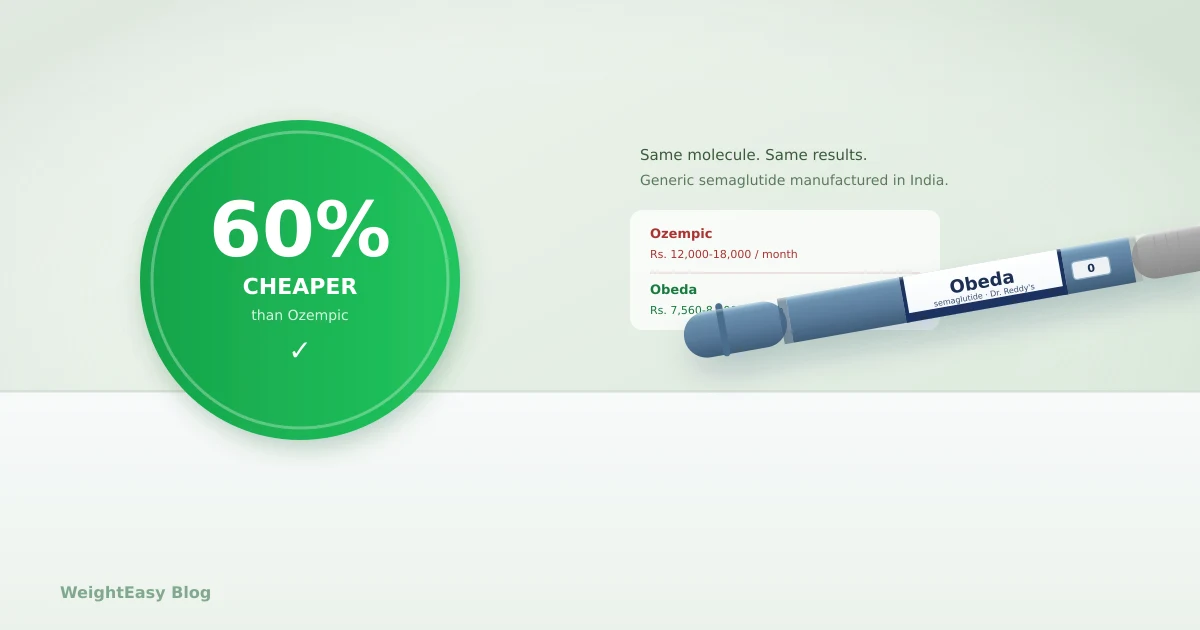
When Obeda launched in India in March 2026, the claim spread quickly: it is 60% cheaper than Ozempic. But is that actually true? And what does that difference mean for Indian patients?
Let us look at the real numbers.
Important: Always consult your healthcare provider before starting any medication. This article is for informational purposes only.
The Price Comparison: Actual Numbers
| Product | Manufacturer | Country | Monthly Cost (est.) |
|---|---|---|---|
| Ozempic 1mg pen | Novo Nordisk | Denmark (imported) | Rs. 12,000-18,000 |
| Obeda 2mg pen | Dr. Reddy's | India | Rs. 7,560-8,400 |
At the common 1mg weekly maintenance dose, the monthly cost comparison looks like this:
- Ozempic: 2 pens x Rs. 6,000-9,000 = Rs. 12,000-18,000
- Obeda: 2 pens x Rs. 3,780-4,200 = Rs. 7,560-8,400
That is a saving of approximately Rs. 4,500 to Rs. 9,600 per month, or Rs. 54,000 to Rs. 1,15,000 per year.
The percentage saving at mid-range: roughly 55-65%. So yes -- the 60% figure is accurate in most real-world scenarios.
Why Does Obeda Cost So Much Less?
The price gap is not about quality -- it is about the economics of pharmaceutical manufacturing and patent law.
1. The Patent Expired
Novo Nordisk held a patent on semaglutide in India. While that patent was active, no other company could legally make the molecule. Novo Nordisk could charge whatever the market would bear -- and for a breakthrough drug, that is typically a very high price.
On March 20, 2026, that patent expired in India. Dr. Reddy's, Sun Pharma, and other Indian manufacturers could now legally produce their own versions.
2. Local Manufacturing vs Importing
Ozempic is manufactured in Novo Nordisk's facilities in Denmark, then imported to India. That means:
- Import duties and customs charges
- Currency conversion (DKK to INR)
- International logistics and cold chain costs
- Importer and distributor margins
Obeda is made in India, for India. None of those costs apply.
3. No Research and Development Recovery
Novo Nordisk spent over a decade and billions of dollars developing semaglutide through clinical trials. Ozempic's price reflects the need to recover that investment plus generate profit.
Dr. Reddy's did not need to rediscover the molecule. It synthesised the same compound under the now-expired patent. The R&D cost is zero for the generic manufacturer -- and that saving flows through to the price.
4. Indian Pharmaceutical Manufacturing Efficiency
India is one of the world's most cost-efficient pharmaceutical manufacturing locations. Indian generic companies produce at enormous scale, with regulatory standards that meet global benchmarks (US FDA, EMA). Low labour costs, high-volume production, and mature supply chains all contribute to significantly lower per-unit manufacturing costs.
Is the Quality the Same?
This is the most important question -- and the answer is yes.
Generic medicines in India must demonstrate bioequivalence to the originator drug before receiving DCGI approval. Bioequivalence means the active molecule is absorbed by the body at the same rate and to the same extent as the branded version.
Dr. Reddy's Laboratories has:
- US FDA-approved manufacturing facilities
- European EMA approval for multiple products
- Over four decades of pharmaceutical manufacturing experience
- A global presence with strong quality control track record
Obeda contains the same semaglutide molecule. The excipients (inactive ingredients) may differ slightly, but these do not affect the drug's clinical action.
Who Benefits Most From the Price Difference?
Patients Already on Ozempic
If you are currently paying Rs. 12,000-18,000 per month for Ozempic and it is working well, you have a strong case to discuss switching to Obeda with your doctor. The active ingredient is identical, and the savings are real. Read about switching from Ozempic to Obeda if you are considering this.
New Patients Starting Semaglutide
If you were previously priced out of Ozempic, Obeda now makes semaglutide accessible. At Rs. 3,800-8,400 per month, it is within range for a much larger segment of the Indian population than Ozempic ever was.
Long-Term Users
At a 1mg weekly dose, the annual saving versus Ozempic is roughly Rs. 54,000 to Rs. 1,15,000. Over two or three years of treatment, that is a transformative difference.
Will the Price Drop Further?
Almost certainly. As of March 2026, at least three Indian manufacturers have launched generic semaglutide: Dr. Reddy's (Obeda), Sun Pharma (Noveltreat, Sematrinity). Competition among generics in India consistently pushes prices down over 12-24 months post-patent expiry.
For context: metformin, the most commonly prescribed diabetes drug in India, now costs as little as Rs. 10 per month. That is the eventual direction of travel for all blockbuster generics. Semaglutide will not reach those levels quickly -- the manufacturing complexity is far higher -- but meaningful additional price reductions are likely.
How WeightEasy Maximises Your Investment
Whether you are paying Rs. 4,000 or Rs. 14,000 per month for semaglutide, the medication is only part of the equation. The Obeda results timeline shows that results depend heavily on diet, consistency, and side effect management -- not just the drug itself.
WeightEasy is built for GLP-1 users in India. Personalised diet guidance, side effect tracking, habit coaching, and progress monitoring -- all designed to help you get better results from your investment in Obeda.
If you are starting Obeda, the right support can make a significant difference. WeightEasy helps you stay consistent, manage side effects, and achieve better results.
The Bottom Line
Yes -- Obeda is genuinely 55-65% cheaper than Ozempic for Indian patients. The savings are real, the quality is equivalent, and the access transformation is significant.
The price difference comes from patent expiry, local manufacturing, and the economics of generic pharmaceutical production in India. You are not getting a lesser drug -- you are getting the same molecule at a fair market price.
Consult your healthcare provider before starting any medication.
Sources
- Dr. Reddy's Laboratories -- Obeda pricing at launch (March 2026)
- PharmEasy product listing -- Obeda 2mg pre-filled pen
- Novo Nordisk India -- Ozempic pricing (2025-2026)
- DCGI bioequivalence requirements for generic medicines in India
- Economic Times Health -- "Pharma Companies Rush Cheap Semaglutide Shots to India" (March 2026)
- Indian Pharmaceutical Alliance -- patent expiry and generic market dynamics report
FAQ
Is Obeda 60% cheaper than Ozempic?
Yes, roughly. At comparable doses, Obeda costs Rs. 3,800-8,400 per month while imported Ozempic in India costs Rs. 10,000-18,000 per month. That is a savings of approximately 55-70% depending on dose and platform.
Why is Obeda so much cheaper than Ozempic if it is the same drug?
Ozempic is manufactured by Novo Nordisk in Denmark and imported into India. Obeda is manufactured locally by Dr. Reddy's Laboratories in India after the semaglutide patent expired in March 2026. Local manufacturing eliminates import costs, patent premiums, and currency conversion markups.
Does cheaper mean lower quality?
No. Generic medicines must demonstrate bioequivalence to the originator drug -- meaning the active molecule behaves identically in the body. Dr. Reddy's is a globally trusted manufacturer with US FDA and European EMA approvals. You are getting the same semaglutide molecule.
Could prices drop even further?
Yes. Multiple Indian companies launched generic semaglutide simultaneously in March 2026. As competition increases, prices typically fall further. Patients starting now may benefit from lower prices within 12-18 months.
Is it worth switching from Ozempic to Obeda for the price savings?
If you are currently on Ozempic and it is working, switching to Obeda for cost savings is a valid discussion to have with your doctor. Since the active molecule is identical, clinical outcomes should be equivalent.