
Obeda Results Timeline: What to Expect Week by Week
When does Obeda start working? This week-by-week timeline covers what happens in your body from week 1 through month 6, based on semaglutide clinical data.
Starting Obeda and wondering what to expect -- and when? The timeline matters. Understanding what happens week by week helps you stay patient during the slow early phase and optimise during the faster middle phase.
This guide walks through the Obeda journey from your first injection to the six-month mark, based on clinical data from semaglutide trials.
Important: Always consult your healthcare provider before starting any medication. This article is for informational purposes only.
The Dose Escalation Schedule
Before getting to the timeline, it helps to understand how dosing works. Obeda follows a step-up protocol:
| Period | Dose | Purpose |
|---|---|---|
| Weeks 1-4 | 0.25mg weekly | Body adjustment, minimise side effects |
| Weeks 5-8 | 0.5mg weekly | Increased appetite suppression |
| Weeks 9-12 | 1mg weekly (if needed) | Maintenance or increased effect |
| Weeks 13+ | 1mg or 2mg weekly | Long-term maintenance |
Not everyone needs to reach 1mg or 2mg. Many patients achieve excellent results at 0.5mg.
Week-by-Week Timeline
Weeks 1-4: The Adjustment Phase
What is happening in your body: Your body is getting used to semaglutide. The GLP-1 receptors in your brain and gut are beginning to respond to the medication.
What you will feel:
- Mild to moderate nausea, especially in the first 1-2 weeks -- the most common early symptom
- Slightly reduced appetite -- meals may feel more satisfying with smaller portions
- Possible fatigue in the first week as your body adjusts
- Some people experience bloating or constipation
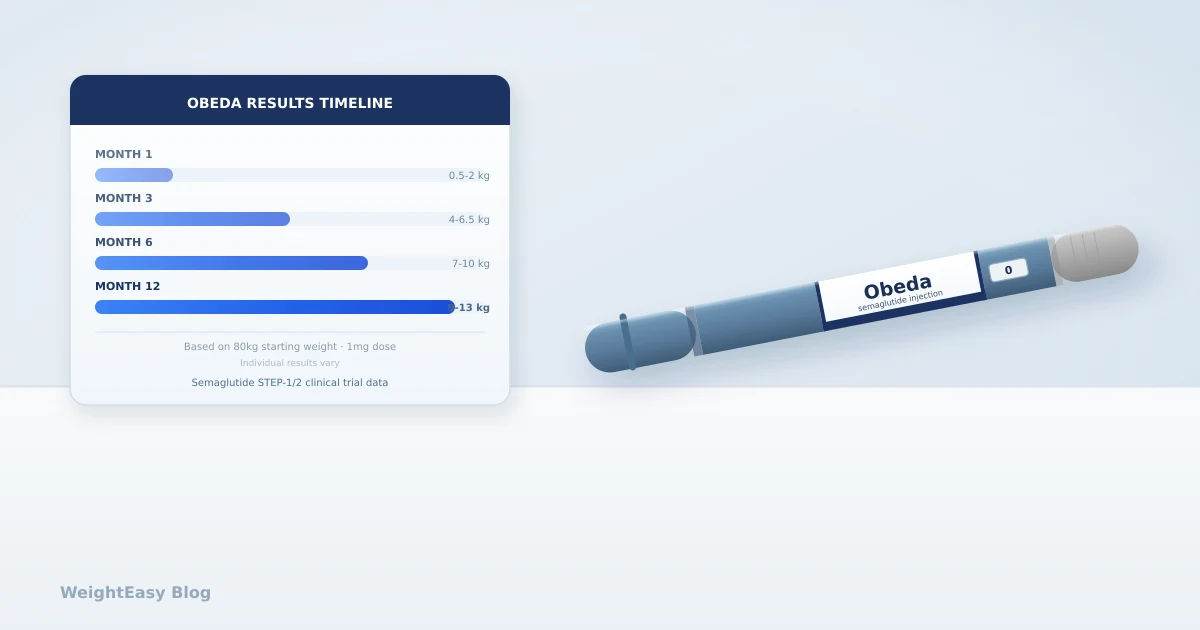
Weight change: Modest -- most people lose 0.5-2 kg in this phase. This is not a failure; the starter dose is designed for safety, not speed.
What to do:
- Eat slowly and stop at the first sign of fullness
- Avoid fatty, heavy meals that worsen nausea
- Stay well hydrated
- Report severe or persistent nausea to your doctor
Weeks 5-8: Appetite Suppression Kicks In
What is happening in your body: At 0.5mg, the GLP-1 effect becomes noticeably stronger. Gastric emptying slows more significantly, and appetite suppression is clearer.
What you will feel:
- Noticeably less hungry between meals
- Smaller appetite at mealtimes -- you may find yourself leaving food on the plate for the first time
- Nausea typically improves in most patients by week 6-7
- Energy may begin to improve as blood sugar levels stabilise
Weight change: This is typically where weight loss accelerates. Expect 1-2 kg per week loss at peak weeks, averaging out to 1-1.5 kg per week across this phase. Total loss from start: commonly 3-6 kg.
What to do:
- Do not skip meals to speed up weight loss -- semaglutide works best with regular, protein-rich meals
- Begin light exercise if you have not already -- even walking 20-30 minutes daily makes a significant difference
- Read what to eat while taking Obeda and apply those principles consistently
Weeks 9-16: Maintenance Dose, Steady Progress
What is happening in your body: At 1mg (if your doctor has titrated you up), semaglutide's full appetite-suppression effect is present. Your body is adapting its metabolic baseline.
What you will feel:
- Consistent, manageable appetite -- hunger is present but no longer feels urgent or overwhelming
- Side effects are typically resolved or minimal by now
- Improved relationship with food -- many patients report fewer cravings, particularly for high-sugar foods
- Better energy and, for diabetics, meaningfully improved blood sugar readings
Weight change: Steady loss of approximately 0.5-1 kg per week. Total weight loss from start: typically 6-10 kg by the end of this phase.
What to do:
- Stay consistent with weekly injections -- skipping doses delays progress
- Keep adjusting your diet as your appetite continues to change
- Track progress with monthly weigh-ins
Months 4-6: Deep Results Phase
What is happening in your body: This is where cumulative weight loss becomes meaningful. Your body has been at a caloric deficit for months. Fat stores are reducing.
What you will feel:
- Physical changes become visible -- clothes fit differently, measurements reduce
- A plateau may begin towards the end of this phase (months 5-6) as the body adapts
- Better metabolic markers -- improved HbA1c (if diabetic), lower blood pressure, better cholesterol in many patients
- Improved sleep quality, joint comfort, and mobility as weight reduces
Weight change: Total weight loss from the start: typically 8-15% of starting body weight by month 6. At 80kg starting weight, that is 6.4-12 kg.
What to do:
- If you hit a plateau, discuss dose optimisation with your doctor
- Do not stop the medication -- plateaus are normal and temporary
- Review your diet quality, not just quantity
The Plateau: What Happens Around Month 6
Almost all semaglutide patients experience a slowdown or plateau somewhere between months 6 and 12. This is normal and reflects the body's adaptation -- it becomes more efficient at a lower weight.
The plateau does not mean the medication has stopped working. It means your calorie needs have decreased as you weigh less, and the deficit is smaller than it was.
Strategies that help:
- A short dietary review with a nutritionist
- Increasing activity level modestly
- Discussing dose adjustment with your doctor
- Patience -- plateaus typically resolve over 4-8 weeks
After 6 Months: What Next?
Most clinical guidance recommends continuing semaglutide for as long as it is producing benefit and is well tolerated. Stopping typically leads to gradual weight regain.
If you stop Obeda after 6 months, the research suggests you will regain approximately 50-60% of lost weight within 12 months unless your dietary and activity habits have significantly and permanently changed.
The goal is to use the medication period to build lasting habits. WeightEasy's coaching is specifically designed to embed those habits during your treatment so results persist beyond it.
How WeightEasy Optimises Each Phase
Each phase of the Obeda timeline has different needs. WeightEasy supports you at every stage:
- Weeks 1-4: Side effect management guidance, gentle dietary adjustments
- Weeks 5-12: Diet optimisation to maximise the appetite window, habit building
- Months 3-6: Progress tracking, plateau prevention strategies, coaching check-ins
- Month 6+: Sustainability coaching to protect long-term results
If you are starting Obeda, the right support can make a significant difference. WeightEasy helps you stay consistent, manage side effects, and achieve better results.
The Bottom Line
Obeda's timeline is: slow start, accelerating middle, steady plateau-navigate. The first month is about tolerating the medication. The second month is when results become visible. Months 3-6 are where the real transformation happens.
The most important thing is consistency. Stay on your dose, adjust your diet, and do not judge the medication by week two.
Consult your healthcare provider before starting any medication.
Sources
- STEP-1 trial: Wilding JPH et al. -- semaglutide 2.4mg, weight loss timeline (NEJM 2021)
- STEP-2 trial: Davies M et al. -- semaglutide in type 2 diabetes and overweight (Lancet 2021)
- Novo Nordisk -- semaglutide dose escalation guidelines
- Dr. Reddy's Laboratories -- Obeda prescribing information (2026)
- WeightEasy clinical advisory team
FAQ
How quickly does Obeda start working?
Obeda begins reducing appetite within the first 1-2 weeks at the starter dose. Visible weight loss typically begins between weeks 4 and 8. Significant results usually appear after 3-6 months of consistent use.
How much weight will I lose in the first month on Obeda?
In the first month, most people are on the 0.25mg starter dose, which is designed to help the body adjust rather than maximise weight loss. Expect 0.5-2 kg in the first 4 weeks. The real results come from month 2 onwards.
Why am I not losing weight in the first few weeks on Obeda?
The starter dose (0.25mg) is intentionally low to minimise side effects. Appetite suppression is mild at this stage. Do not judge the medication by week 2. Results accelerate significantly once you reach the 0.5mg and 1mg doses.
When does Obeda reach full effectiveness?
Most patients reach their maintenance dose (0.5mg or 1mg) by weeks 8-12. Full effectiveness at the maintenance dose becomes evident from around month 3-4, with the most significant weight loss occurring between months 3 and 9.
What happens if I stop Obeda after 3 months?
Stopping semaglutide typically leads to gradual weight regain as appetite returns to pre-treatment levels. Most research shows significant weight regain within 12 months of stopping. Sustained results require sustained treatment or well-established lifestyle changes.
Is it normal to plateau on Obeda?
Yes. Most patients experience a plateau around months 6-9 as the body adapts. This is normal and does not mean the medication has stopped working. Reviewing diet, activity, and dose with your doctor can help move through a plateau.