
AMG 133 (MariTide): Amgen’s Monthly Weight Loss Injection Explained
A practical guide to AMG 133, now called MariTide, including how it works, what phase 1 and phase 2 studies showed, and where development stands in 2026.
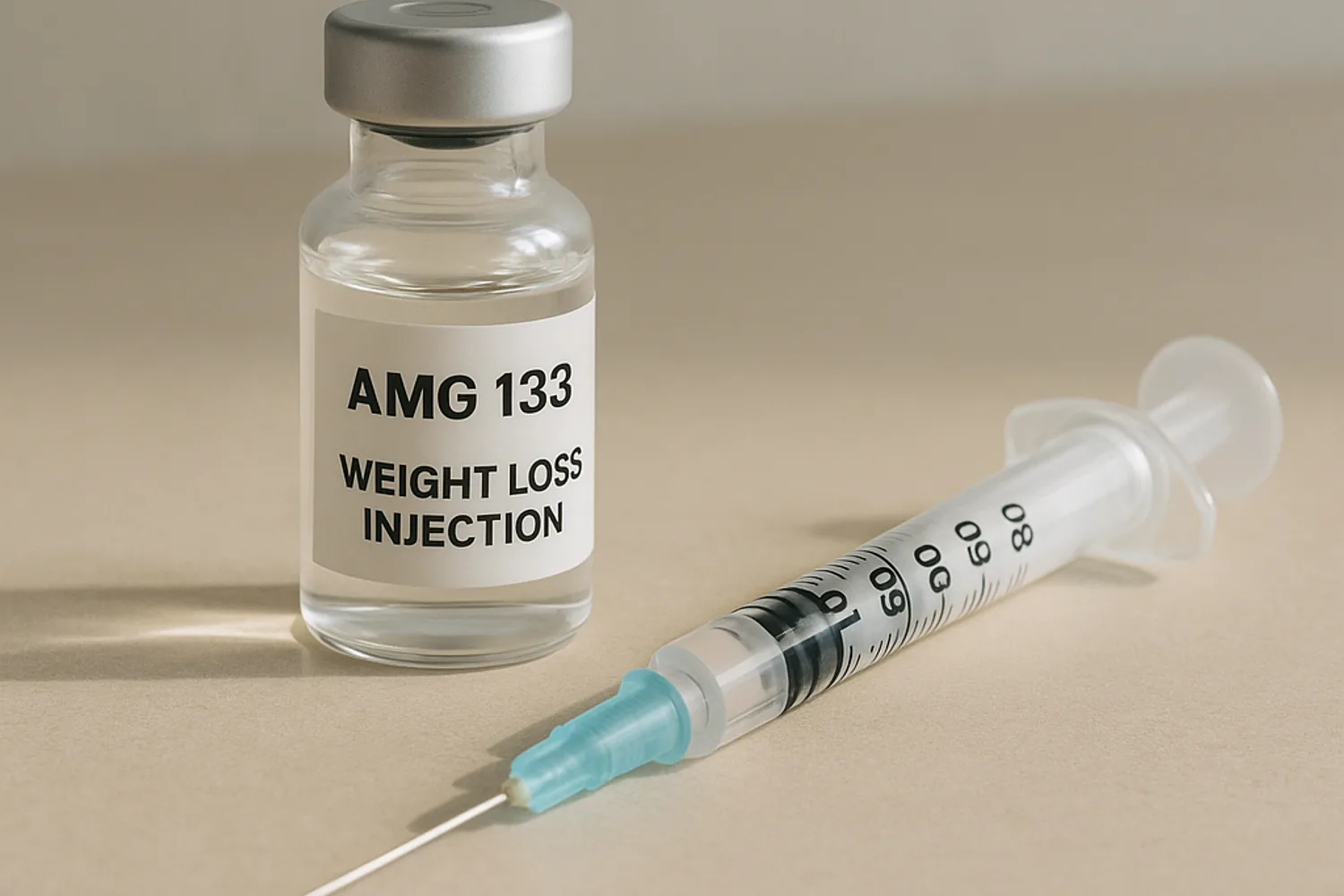
AMG 133 (MariTide): Amgen’s Monthly Weight Loss Injection Explained
AMG 133 is the older development name for maridebart cafraglutide, which Amgen now calls MariTide. It is one of the more closely watched obesity drugs in development because it aims to combine strong weight loss with monthly or even less frequent dosing.
That makes it different from the current big-name obesity injections, which are generally given once a week.
This guide explains what MariTide is, how it works, what the studies have shown so far, and where the program stands as of May 8, 2026. It is still an investigational medicine, which means it is not yet approved for routine public use. Consult your healthcare provider before starting any medication.
What is AMG 133?
AMG 133 is Amgen’s investigational obesity and metabolic-disease drug now known as MariTide.
Amgen describes it as a long-acting peptide-antibody conjugate with a dual mechanism:
- GLP-1 receptor agonist activity
- GIP receptor antagonist activity
That second part is what makes it stand out.
How is MariTide different from semaglutide or tirzepatide?
Most people compare new obesity medicines to semaglutide or tirzepatide.
- Semaglutide works as a GLP-1 receptor agonist
- Tirzepatide works as a GLP-1 + GIP receptor agonist
- MariTide uses GLP-1 agonism + GIP receptor antagonism
So unlike tirzepatide, MariTide does not turn the GIP receptor on. It blocks it.
That sounds counterintuitive at first, but Amgen’s development theory is that activating GLP-1 while inhibiting GIP signaling may produce a powerful and durable weight-loss effect.
Why does monthly dosing matter?
One of MariTide’s biggest selling points is convenience.
Amgen has described MariTide as a monthly or less frequently dosed treatment under investigation. If that eventually works well in practice and gets approved, it could matter for:
- adherence
- convenience
- long-term treatment persistence
- people who dislike weekly injections
That does not guarantee it will be the best option, but it is a major differentiator.
What did the early studies show?
Phase 1
The phase 1 work established that AMG 133 had the intended dual biology and produced meaningful early weight-loss signals.
A Nature Metabolism paper described the molecule as a GIPR antagonist conjugated to GLP-1 analogues and reported encouraging preclinical and phase 1 findings. A Nature Reviews Endocrinology summary highlighted that the molecule showed both GIPR antagonist and GLP-1 agonist activity.
Phase 2
The bigger turning point was Amgen’s phase 2 obesity study.
In Amgen’s November 26, 2024 update, the company said MariTide showed:
- up to about 20% average weight loss at 52 weeks in people living with obesity or overweight without type 2 diabetes
- up to about 17% average weight loss at 52 weeks in people living with obesity or overweight with type 2 diabetes
- no weight-loss plateau by 52 weeks
- meaningful improvements in several cardiometabolic measures
Then in June 2025, Amgen presented fuller phase 2 results and said lower-dose initiation strategies improved gastrointestinal tolerability without losing efficacy.
What side effects have been reported so far?
So far, the side-effect profile sounds broadly familiar for an incretin-style obesity medicine.
Amgen said the most frequently reported adverse events were gastrointestinal, and most were mild to moderate. That generally means symptoms like:
- nausea
- vomiting
- stomach upset
- related GI discomfort
That does not mean the safety story is fully settled. MariTide is still in development, and larger/longer trials are exactly where less obvious safety and tolerability patterns become clearer.
Is AMG 133 approved yet?
No. As of May 8, 2026, MariTide / maridebart cafraglutide is not an FDA-approved obesity medicine.
It remains an investigational drug in Amgen’s clinical development program.
Where does development stand now?
MariTide has moved well beyond the earliest testing stage.
Phase 3 obesity program
Amgen’s MARITIME phase 3 program is underway.
ClinicalTrials.gov shows active phase 3 studies including:
- MARITIME-2 (NCT06858878) in adults with type 2 diabetes who have obesity or are overweight
- additional phase 3 expansion into obesity-related conditions such as heart failure with preserved or mildly reduced ejection fraction (MARITIME-HF, NCT07037459)
Additional metabolic studies
There is also a phase 2b liver-fat study (NCT07441252) evaluating maridebart cafraglutide in adults with obesity or overweight and elevated liver fat.
That is a useful sign that Amgen is trying to position the drug beyond simple scale-weight reduction and into broader cardiometabolic disease.
Could MariTide become a major obesity drug?
It could, but it is too early to say that with confidence.
Reasons people are paying attention:
- the monthly or less frequent dosing concept
- strong phase 2 weight-loss data
- no reported plateau by 52 weeks in the phase 2 update
- expansion into obesity-related disease programs
Reasons for caution:
- it is still unapproved
- phase 3 data are still needed
- long-term safety, adherence, and comparative positioning are not fully known
- approval timing and final labeling remain uncertain
Bottom line
As of May 8, 2026, AMG 133 — now called MariTide — is one of the most important obesity drugs still in development. It combines GLP-1 agonism with GIP receptor antagonism, and Amgen’s phase 2 updates have shown up to ~20% average weight loss at 52 weeks in people without diabetes and up to ~17% in people with diabetes, with monthly or less frequent dosing under investigation.
That is why it keeps showing up in obesity-drug conversations. But it is still an investigational medicine, not a treatment you can routinely get today. For now, it is best understood as a promising next-wave candidate rather than a currently available option. Consult your healthcare provider before starting any medication.
Sources
- Amgen phase 2 MariTide update, November 26, 2024: https://www.amgen.com/newsroom/press-releases/2024/11/amgen-announces-robust-weight-loss-with-maritide-in-people-living-with-obesity-or-overweight-at-52-weeks-in-a-phase-2-study
- Amgen ADA 2025 / full phase 2 results update, June 23, 2025: https://www.amgen.com/newsroom/press-releases/2025/06/results-from-amgens-phase-2-obesity-study-of-monthly-maritide-presented-at-the-american-diabetes-association-85th-scientific-sessions
- ClinicalTrials.gov — phase 2 obesity dose-ranging study (NCT05669599): https://clinicaltrials.gov/study/NCT05669599
- ClinicalTrials.gov — MARITIME-2 phase 3 study (NCT06858878): https://clinicaltrials.gov/study/NCT06858878
- ClinicalTrials.gov — elevated liver fat study (NCT07441252): https://clinicaltrials.gov/study/NCT07441252
- Nature Reviews Endocrinology summary of phase 1 results: https://www.nature.com/articles/s41574-024-00967-z
Written by
Dietician / Nutritionist
Health Content Writer
Varshitha Sotala is a Dietician / Nutritionist professional who contributes evidence-informed health and wellness content for WeightEasy.
View profile →Reviewed by
BHMS
Senior Medical Reviewer
Dietitian with experience in nutrition counseling, meal planning and promoting healthy lifestyles. Dedicated to help individuals achieve optimal health and well-being through personalized nutrition strategies. Skilled in providing expert guidance for managing conditions like diabetes, weight challenges and Lifestyle management.
View profile →