
How to Reduce Nausea on Obeda: 10 Proven Strategies
Nausea is the most common Obeda side effect. These 10 evidence-based strategies help you manage it effectively so you can stay on the medication and see results.
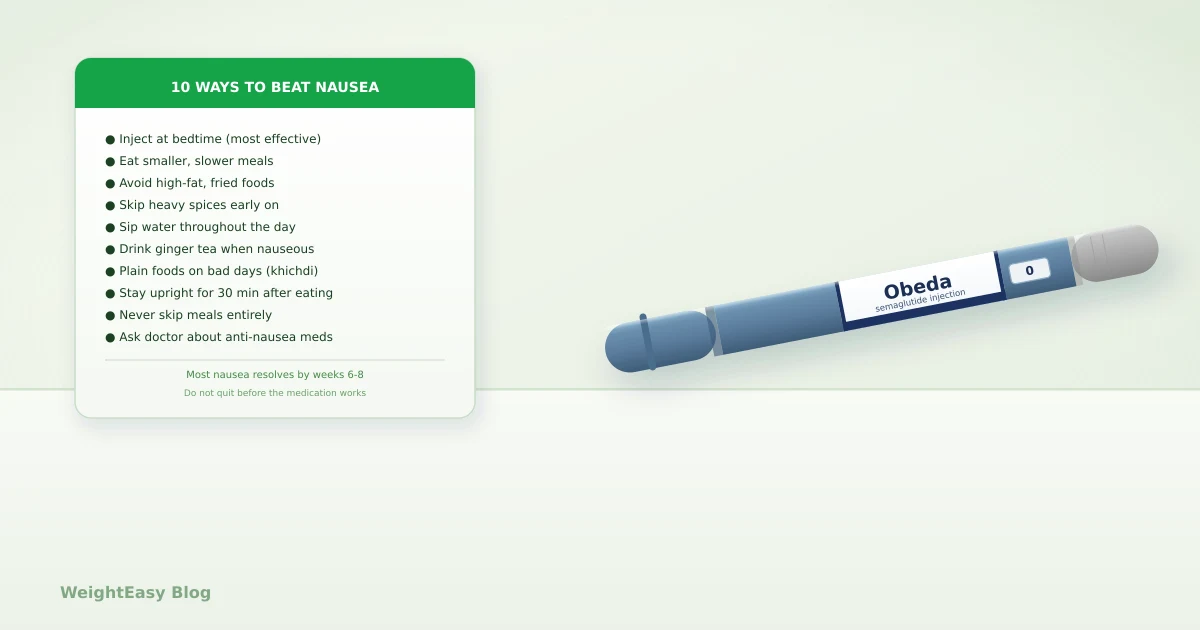
Nausea is the price of admission for many patients starting Obeda. It is not pleasant, but it is temporary -- and manageable. The patients who push through the first 6-8 weeks typically go on to excellent results. Those who quit early miss out.
These 10 strategies are based on what works for patients on semaglutide globally -- adapted for Indian patients and Indian lifestyles.
Important: Always consult your healthcare provider before making changes to your medication routine. This article is for informational purposes only.
Why Obeda Causes Nausea
Understanding the cause helps you manage it better. Obeda slows gastric emptying -- the rate at which food leaves your stomach. This is part of why it reduces appetite and promotes weight loss.
The downside is that when food lingers in the stomach longer than usual, the brain can interpret this as an oversupply -- which triggers nausea. This effect is strongest in the early weeks when your GLP-1 receptors are adjusting to the constant stimulation of semaglutide.
The good news: the body adapts. Most patients find nausea becomes much more manageable after 6-8 weeks.
Strategy 1: Inject at Bedtime
This is the single most effective strategy for most patients.
Obeda peaks in your system roughly 4-8 hours after injection. If you inject on a Sunday morning at 8 AM, you may feel the worst nausea in the early afternoon. If you inject on Saturday evening at 9 PM, you sleep through most of the peak window.
Action: Move your weekly injection to the evening before bedtime. Many patients call this the single change that made Obeda tolerable.
Strategy 2: Eat Smaller, Slower Meals
Large meals combined with Obeda's slowed gastric emptying is a reliable recipe for severe nausea. The stomach is already slow to empty; a large meal overloads it.
Reduce your meal size by 20-30% from what you would normally eat. Eat slowly -- put the fork down between bites. Stop the moment you feel comfortably satisfied, not full. Eating past satisfaction is the most common trigger for vomiting on semaglutide.
Indian practical tip: Serve yourself a smaller portion than usual when dishing out food. It is much easier not to eat it if it is not on your plate.
Strategy 3: Avoid High-Fat Foods (Especially Early On)
Fat is the slowest macronutrient to leave the stomach. Combined with Obeda's already-slowed emptying, high-fat meals cause food to sit in the stomach for significantly longer than normal -- dramatically worsening nausea.
In the first 8 weeks, minimise:
- Deep-fried snacks (pakoras, samosas, bhajji, chips)
- Heavy, oily curries (reduce oil/ghee significantly)
- Full-fat dairy in large amounts
- Fatty meats (fatty mutton, processed meats)
This is the most impactful dietary change for reducing nausea.
Strategy 4: Avoid Strong Spices Early On
Heavy masala and chilli-rich cooking can irritate the stomach lining and worsen nausea when combined with semaglutide. This does not mean bland food forever -- but in the first 4-8 weeks, lighter seasoning helps significantly.
Reduce heavy tadkas, excessive chilli, and strong spice blends in the early weeks. Return to your normal spice levels gradually as nausea settles.
Strategy 5: Stay Hydrated -- Sip, Do Not Gulp
Dehydration worsens nausea. But drinking large amounts of water at once can also trigger it by adding volume to an already-slow-emptying stomach.
Sip water consistently throughout the day rather than drinking a large glass at once. Aim for 2-2.5 litres total. Coconut water, thin chaas (buttermilk), and diluted nimbu pani (lemon water) are excellent options that are also easy on the stomach.
Avoid carbonated drinks entirely -- they cause gas and bloating that significantly worsen nausea.
Strategy 6: Ginger Is Your Friend
Ginger has well-documented anti-nausea properties. It is one of the most widely used and evidence-supported natural remedies for nausea of various causes.
How to use:
- Fresh ginger tea (thin slices of ginger steeped in hot water with a little honey) -- sip slowly when nausea strikes
- Small piece of raw ginger to chew
- Ginger-infused warm water throughout the day
This is one of the most India-friendly nausea strategies and costs almost nothing.
Strategy 7: Choose Plain, Easily Digestible Foods During Bad Days
On your worst nausea days (typically the 1-2 days after your weekly injection), eat the simplest, most easily digestible foods:
- Plain khichdi (rice and moong dal, lightly cooked, minimal spice)
- Boiled rice with dal water
- Plain curd (room temperature, not cold)
- Banana
- Toast with a small amount of butter
- Thin soup
Save your normal meals for the days when nausea is milder (typically days 3-7 of your weekly cycle).
Strategy 8: Do Not Lie Down Immediately After Eating
Lying down after a meal when gastric emptying is slowed significantly increases the risk of reflux and worsens nausea. Stay upright for at least 30-60 minutes after eating.
A gentle 10-15 minute walk after meals can actually help by stimulating gut motility and reducing the backed-up feeling that Obeda can create.
Strategy 9: Do Not Skip Meals
Counterintuitively, an empty stomach can worsen nausea on Obeda. The stomach continues to produce acid even when empty, and with slowed motility, this can cause significant discomfort.
Eat small amounts at regular intervals even if you are not hungry. A few crackers, a small bowl of curd, or a banana is enough to line the stomach. Do not go more than 4-5 hours without eating anything.
Strategy 10: Ask Your Doctor About Anti-Nausea Medication If Needed
If dietary and timing strategies are not sufficient, your doctor can prescribe appropriate anti-nausea support. Options your doctor might consider include:
- Ondansetron (commonly prescribed, well-tolerated)
- Metoclopramide (also helps with gastric emptying)
- Domperidone (widely available in India, helps with gastroparesis symptoms)
Do not self-prescribe. Tell your doctor about the nausea severity so they can help. Nausea that prevents eating or causes significant vomiting for more than a few days should be reported.
When to Stop Pushing Through
Most nausea on Obeda is manageable and worth pushing through. But there are situations where you should contact your doctor:
- Vomiting that prevents you from keeping any food or water down
- Nausea accompanied by severe abdominal pain (possible pancreatitis)
- Weight loss that is happening too rapidly (more than 1.5-2 kg per week consistently)
- Significant fatigue or weakness alongside nausea
These signs go beyond normal adjustment nausea and need medical evaluation.
How WeightEasy Supports Nausea Management
Side effects are the most common reason people stop Obeda before they see results. WeightEasy's platform includes structured side effect management -- specific guidance on what to eat, when to eat, injection timing strategies, and when to escalate to your doctor.
Combined with diet guidance tailored to Obeda users and habit coaching, WeightEasy helps patients stay on the medication long enough to achieve the results it is capable of.
If you are starting Obeda, the right support can make a significant difference. WeightEasy helps you stay consistent, manage side effects, and achieve better results.
The Bottom Line
Nausea on Obeda is real, temporary, and manageable. The injection timing strategy (bedtime), small low-fat meals, ginger tea, and hydration are your first line of defence. For most patients, nausea becomes a minor inconvenience by week 8.
Push through the first 6-8 weeks. The results on the other side are worth it.
Consult your healthcare provider before starting any medication or before taking any anti-nausea medication alongside Obeda.
Sources
- STEP-1 trial adverse event data -- nausea prevalence and duration on semaglutide
- Novo Nordisk -- semaglutide side effect management guidance
- Ernst E, Pittler MH -- efficacy of ginger for nausea and vomiting (British Journal of Anaesthesia)
- Pharmacology of anti-nausea agents for GLP-1-associated nausea
- WeightEasy clinical advisory team
FAQ
How long does nausea last on Obeda?
For most patients, nausea is most intense in weeks 1-4 and improves significantly by weeks 6-8. Some patients experience mild, intermittent nausea throughout treatment, but severe nausea typically resolves as the body adjusts to semaglutide.
Does nausea get worse with each dose increase?
It can temporarily worsen when the dose is increased. Each step up (0.25mg to 0.5mg, 0.5mg to 1mg) may bring a brief return or worsening of nausea for 1-2 weeks. This typically settles as the body adjusts to the new dose.
Should I stop taking Obeda if the nausea is severe?
Do not stop without consulting your doctor. Severe nausea can often be managed with dietary adjustments, injection timing changes, and occasionally anti-nausea medication. Stopping too early means losing the benefits you have already built. Call your doctor before discontinuing.
Can I take anti-nausea medication with Obeda?
Some anti-nausea medications (like ondansetron or metoclopramide) can be prescribed by your doctor if dietary strategies are not sufficient. Do not self-medicate without your doctor's guidance.
Does taking Obeda at night reduce nausea?
Yes -- many patients find that taking their weekly injection in the evening before bedtime means they sleep through the peak nausea window (typically 4-8 hours post-injection). This is one of the most effective timing strategies.
What foods trigger the worst nausea on Obeda?
High-fat foods, heavily spiced dishes, large meals, and fried foods consistently trigger the worst nausea on semaglutide. These foods combine with Obeda's slowed gastric emptying to keep food in the stomach for extended periods.