
Long-Term Use of Semaglutide: Is It Safe? What the Evidence Says
Is it safe to take semaglutide (Obeda) for years? This evidence-based guide covers the long-term safety data on semaglutide, what is known, what is not, and what Indian patients should consider.
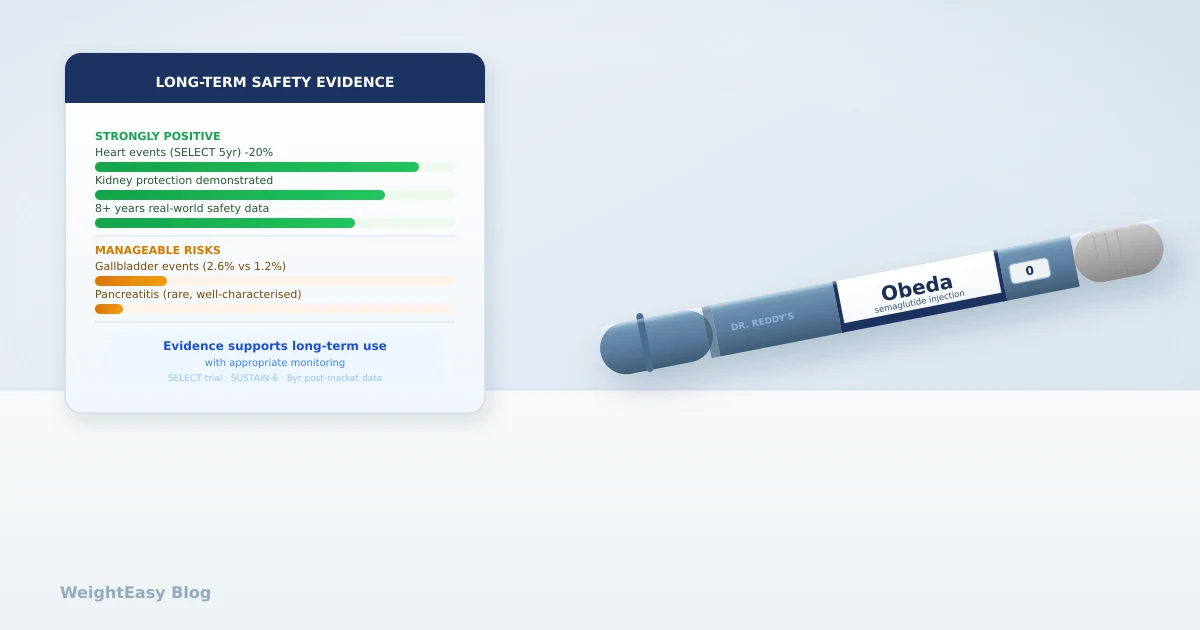
When you are considering taking a medication for months or years, the long-term safety profile matters enormously. With semaglutide-based medications like Obeda now available in India, it is a fair and important question: what does the evidence actually say about long-term use?
The answer is more reassuring than many patients expect -- with some important nuances worth understanding.
Important: Always consult your healthcare provider before starting or continuing any long-term medication. This article is for informational purposes only.
How Much Long-Term Data Exists?
Semaglutide (Ozempic) was first approved for type 2 diabetes in 2017. That means there is now approximately 8-9 years of real-world global data on semaglutide use.
The landmark trials provide controlled data up to 4-5 years:
- SUSTAIN-6: 2-year cardiovascular outcomes trial in type 2 diabetes patients
- SELECT trial: 5-year cardiovascular outcomes trial in patients with obesity without diabetes (completed 2023)
- STEP trials: Up to 68 weeks (approximately 16 months) of controlled weight management data
For a medication that has been in widespread global use since 2017-2018, the safety record to date is notably positive.
What the Long-Term Evidence Shows
Cardiovascular Safety: Strongly Positive
The SELECT trial (published NEJM 2023) was a landmark study. Over 17,000 patients with obesity but no diabetes were followed for an average of 5 years on semaglutide 2.4mg. The result:
- 20% reduction in major adverse cardiovascular events (heart attack, stroke, cardiovascular death) compared to placebo
- No increase in cardiovascular risk from long-term semaglutide use
This was not a neutral safety signal -- it was a strongly positive cardiovascular outcome. For patients with obesity at cardiovascular risk, long-term semaglutide appears to actively protect the heart, not harm it.
Kidney Health: Protective
The SUSTAIN-6 trial and subsequent analyses showed semaglutide users had significantly lower rates of:
- New or worsening kidney disease
- Macroalbuminuria (protein in urine, a sign of kidney damage)
- Requirement for dialysis
Long-term renal harm from semaglutide has not been demonstrated. For diabetic patients with kidney risk, it is one of the most kidney-protective diabetes medications available.
Pancreatic Safety
Pancreatitis is a known, rare risk with GLP-1 medications and has been monitored closely since their introduction. Long-term trial data shows:
- Acute pancreatitis cases are rare and not significantly elevated above background rates
- Chronic pancreatitis or pancreatic cancer has not been demonstrated to be caused by semaglutide after 8+ years of data
- Patients with a personal history of pancreatitis should still discuss risk carefully with their doctor
Thyroid Safety
Animal studies at very high doses showed thyroid C-cell tumours (medullary thyroid carcinoma) in rodents. This led to the contraindication for patients with a history of MTC or MEN2.
In human data -- including registry studies and 8+ years of post-marketing surveillance -- no increase in medullary thyroid carcinoma rates has been observed.
The contraindication remains as a precaution given the animal data, but the human evidence to date does not support this being a significant risk in the general population.
Mental Health
A concern raised in 2023-2024 was whether GLP-1 medications could cause suicidal thoughts or depression. The European Medicines Agency and FDA both investigated this after preliminary reports. Both agencies concluded, based on available data, that there is no established causal link between semaglutide and suicidal ideation. More long-term data will continue to accumulate, but this does not currently represent an established safety signal.
Gallbladder
Weight loss from any cause increases gallstone risk -- and semaglutide users do have a modestly elevated gallbladder event rate in trials. The STEP trials showed approximately 2.6% gallbladder events in the semaglutide group vs 1.2% in placebo.
This is a real but modest risk. Patients with a history of gallbladder disease should discuss it with their doctor. For most patients, the cardiovascular and metabolic benefits far outweigh this gallbladder risk.
What We Do Not Yet Know
Scientific honesty requires acknowledging the limits of current data:
- Very long-term use (10-20+ years): The oldest human data is approximately 8-9 years. Ultra-long-term effects in some areas remain unknown.
- Use in younger age groups: Most trial data involved adults 30 and older. Long-term use in patients starting in their 20s has less data.
- Emerging safety signals: Post-marketing surveillance is ongoing. New signals, if they emerge, will be added to prescribing information.
These gaps do not constitute evidence of harm -- they are simply the known limits of evidence accumulated to date on a relatively new medication class.
The Chronic Condition Framework
The most useful frame for thinking about long-term semaglutide use is the same frame used for other chronic disease medications.
We do not ask whether blood pressure medication is "safe long-term" and conclude it should only be taken for 6 months. We accept that hypertension is a chronic condition requiring ongoing treatment, and we monitor for side effects while continuing the treatment that provides benefit.
Obesity is similarly a chronic, relapsing condition. The International Obesity Federation, World Obesity Federation, and most national medical bodies now classify obesity as a chronic disease requiring chronic management. Stopping semaglutide typically leads to weight regain because the underlying condition has not been cured -- it has been managed.
Long-term use, with appropriate monitoring, is supported by the weight of current evidence for patients who continue to benefit from it.
What Monitoring Looks Like Long-Term
For patients on Obeda long-term, a reasonable monitoring schedule includes:
| Frequency | Tests and Assessments |
|---|---|
| Every 3 months (first year) | Weight, blood pressure, blood sugar, side effect review |
| Every 6 months (ongoing) | HbA1c, kidney function, full metabolic panel |
| Annually | Thyroid function, liver enzymes, eye exam (diabetics), overall health review |
| As needed | Gallbladder ultrasound if symptoms arise, cardiac evaluation |
This is not burdensome -- it is standard chronic disease management.
How WeightEasy Supports Long-Term Patients
Long-term semaglutide use works best when lifestyle habits are built and maintained alongside the medication. WeightEasy's coaching, dietary guidance, and progress tracking are designed to support not just short-term results but the sustainable long-term management of weight and metabolic health.
If you are considering Obeda as a long-term treatment, the right support structure is what makes that commitment worthwhile. WeightEasy helps you stay consistent, manage side effects, and achieve better results.
The Bottom Line
Based on available evidence from 8+ years of global use and controlled trials up to 5 years, semaglutide has a notably positive long-term safety profile. Cardiovascular outcomes are improved, not worsened. Kidney protection is demonstrated. The known risks -- gallbladder events, rare pancreatitis, GI side effects -- are manageable and well-characterised.
For patients who need ongoing obesity management, current evidence supports long-term semaglutide use with appropriate monitoring. The evidence will continue to accumulate, and guidance should be updated accordingly.
Consult your healthcare provider before starting or continuing any long-term medication. Individual health profiles vary significantly.
Sources
- Lincoff AM et al. -- SELECT trial: semaglutide and cardiovascular outcomes in obesity (NEJM 2023)
- Marso SP et al. -- SUSTAIN-6: cardiovascular and renal outcomes with semaglutide (NEJM 2016)
- European Medicines Agency -- semaglutide safety review (suicidal ideation, 2024)
- FDA -- GLP-1 long-term safety monitoring update (2024)
- World Obesity Federation -- obesity as a chronic disease framework (2023)
- WeightEasy clinical advisory team
FAQ
Is it safe to take semaglutide long-term?
Based on available evidence up to 4-5 years of use, semaglutide appears safe for most patients when monitored appropriately. Long-term cardiovascular outcomes data (SUSTAIN-6, SELECT trial) show significant heart benefits, not harm. No major safety signals have emerged beyond the known side effect profile.
How long can I take Obeda?
Obesity is recognised as a chronic condition requiring ongoing management. Current guidelines from major medical bodies support long-term use of semaglutide as a chronic treatment, similar to long-term use of blood pressure or cholesterol medication. The decision to continue or stop should be made with your doctor based on ongoing benefit and tolerability.
Does semaglutide cause cancer?
Animal studies showed thyroid C-cell tumours at very high doses of semaglutide, but this has not been observed in human clinical trials or post-marketing surveillance over 8+ years of Ozempic use globally. Semaglutide is contraindicated in people with personal or family history of medullary thyroid carcinoma as a precaution.
Does long-term semaglutide cause kidney damage?
No. Clinical data shows semaglutide has renal-protective effects in diabetic patients. SUSTAIN-6 showed significant reduction in kidney disease progression. Long-term kidney damage from semaglutide has not been demonstrated.
Does the body become dependent on semaglutide?
Semaglutide does not cause physical dependence or addiction. However, the obesity it treats is a chronic condition -- stopping the medication typically leads to weight regain as appetite returns. This is different from dependence; it is the natural history of the underlying condition.
What monitoring is needed for long-term Obeda use?
Regular monitoring includes: weight and BMI, blood pressure, HbA1c (if diabetic), kidney function, thyroid function, eye examination (for diabetic patients), gallbladder assessment if symptoms arise, and general health review every 6-12 months.