
Obeda Not Working? 6 Fixes That Actually Help
Not losing weight on Obeda? Before giving up, try these 6 targeted fixes. Most cases of poor semaglutide response have an identifiable and correctable cause.
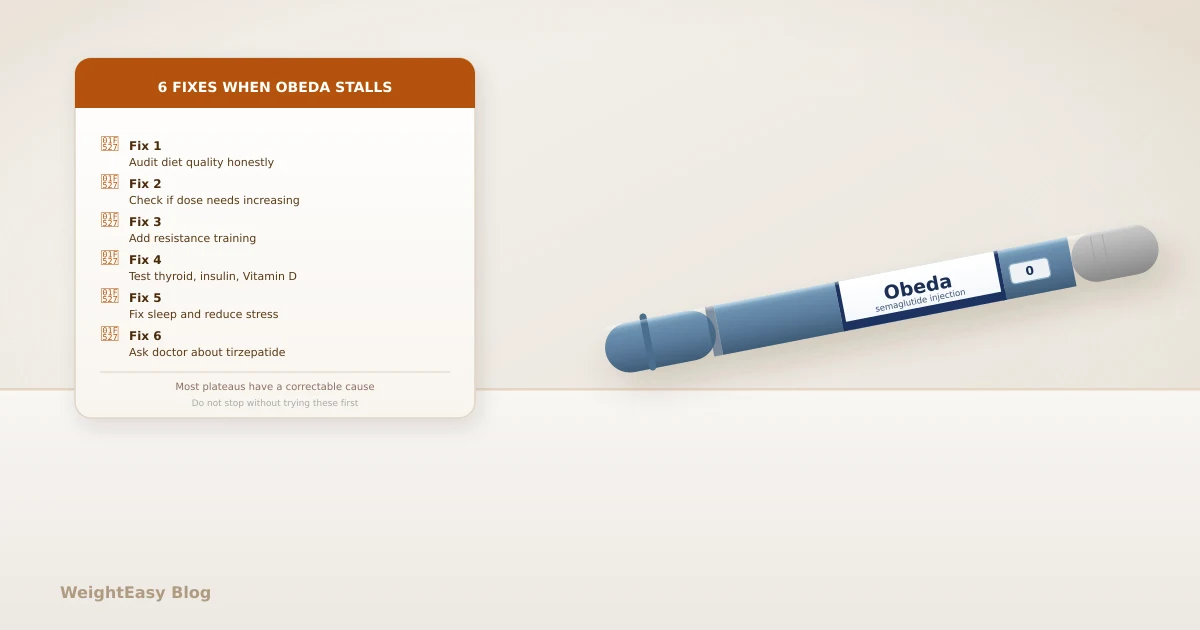
You started Obeda with reasonable expectations. You took your weekly injections consistently. A few months in, the weight loss has slowed -- or stopped. What now?
Before concluding that the medication is not working for you, work through these six targeted fixes. Most cases of poor or plateaued semaglutide response have a specific, identifiable, and correctable cause.
Important: Always consult your healthcare provider before making changes to your medication or dosing. This article is for informational purposes only.
Fix 1: Audit Your Diet Honestly
This is the most common root cause of poor results on Obeda -- and the most frequently underestimated.
Obeda dramatically reduces appetite. But it does not determine what you eat. Many patients eat smaller portions of the same low-quality foods: refined carbohydrates, fried snacks, sugary drinks. The calorie deficit is smaller than they think.
Do this audit honestly:
- How much protein are you eating per day? (Target: 1.2-1.5g per kg body weight)
- How often are you eating fried or high-fat foods?
- Are sugary drinks, chai with sugar, or packaged snacks still part of your regular intake?
- Are your carbohydrate portions genuinely smaller, or just slightly smaller?
Most patients who plateau find, on honest reflection, that dietary quality has drifted. A 2-week strict return to the dietary principles in the Obeda diet guide often restarts progress.
Practical step: Keep a 7-day food diary (photos work better than memory). Review it with your doctor or a dietitian.
Fix 2: Check Your Dose
If you are seeing appetite suppression but minimal weight loss, and you have been at 0.5mg for 8+ weeks, you may be under-dosed.
The STEP trials showed meaningfully better results at 1mg versus 0.5mg, and at 2.4mg (Wegovy dose) versus 1mg. While 2.4mg is not currently available in Obeda's standard formulation, titrating from 0.5mg to 1mg is a standard clinical step.
Who should discuss dose increase:
- On 0.5mg for 8+ weeks with good tolerability but insufficient weight loss
- On 1mg for 12+ weeks with a plateau that diet and activity review has not resolved
What to do: Bring your progress data (weight trend) to your next consultation and specifically ask about dose optimisation. Do not self-escalate.
Fix 3: Add or Intensify Resistance Training
If your exercise consists purely of walking or light cardio, you may be losing muscle alongside fat -- and a lower muscle mass means a lower resting metabolic rate, which reduces the calorie deficit over time.
Adding 2-3 resistance training sessions per week can:
- Preserve and rebuild muscle mass
- Increase resting metabolic rate
- Break through a plateau even without dose changes
Starting point: 2 sessions per week, 30 minutes each. Bodyweight exercises (squats, push-ups, lunges) are effective if you do not have gym access. See the full exercise guide for Obeda users for a structured plan.
The combination of increased protein and resistance training is one of the most reliably effective plateau-busters on semaglutide.
Fix 4: Investigate Underlying Conditions
Several common Indian health conditions actively block weight loss on semaglutide and go undetected without testing.
Get these checked if you have not recently:
Thyroid function (TSH, free T4): Hypothyroidism affects an estimated 10-15% of Indian women and is significantly underdiagnosed. Even subclinical hypothyroidism reduces metabolic rate and can completely offset semaglutide's weight loss effect. Treatment (levothyroxine) is simple and the impact on weight loss is significant.
Fasting insulin and HOMA-IR: Severe insulin resistance beyond what Obeda addresses may require additional management (such as metformin or SGLT2 inhibitors alongside Obeda).
Cortisol (8 AM serum or 24-hour urine): Chronic stress elevates cortisol, which promotes abdominal fat retention and actively resists weight loss. Rarely, high cortisol may indicate Cushing's syndrome -- a condition that prevents weight loss on any treatment.
Vitamin D: Severe Vitamin D deficiency (extremely common in India) is associated with impaired fat metabolism and insulin resistance. A simple, cheap supplement can make a meaningful difference.
Fix 5: Address Sleep and Stress Directly
These are consistently treated as soft factors but have hard metabolic consequences.
Sleep deprivation:
- Raises ghrelin (hunger hormone) by up to 28%
- Reduces leptin (satiety hormone)
- Elevates cortisol
- Reduces insulin sensitivity
- Directly counteracts semaglutide's appetite-suppression mechanism
If you are sleeping less than 6.5 hours per night, Obeda is fighting your biology with one hand tied behind its back. Addressing sleep quality is a legitimate medical intervention, not a lifestyle nicety.
Chronic stress: High cortisol from chronic work, financial, or personal stress promotes visceral fat deposition specifically -- the exact fat store that Obeda is working to reduce. Stress management -- whether through exercise, meditation, social support, or reducing stressors -- is a clinical tool, not an optional extra.
Practical steps: Sleep hygiene (consistent sleep and wake times, dark room, no screens 30 min before bed). For stress: 10-15 minutes of structured breathing or meditation daily has documented cortisol-lowering effects.
Fix 6: Consider Whether a Different Molecule Is Needed
A small minority of patients are genuinely low-responders to semaglutide -- the GLP-1 receptor agonist class. In these cases, a different mechanism of action may produce better results.
Tirzepatide (Mounjaro) is a dual GIP/GLP-1 agonist available in India. The SURMOUNT-1 trial showed average weight loss of 20.9% at the highest dose -- meaningfully higher than semaglutide's 14.9% in the STEP-1 trial. For patients who have plateaued or responded poorly to semaglutide despite optimising all modifiable factors, tirzepatide is the next clinical step to discuss.
Tirzepatide is more expensive (Rs. 18,000-25,000 per month currently), but for genuine semaglutide non-responders, it can produce results that semaglutide cannot.
What to do: Raise this with your doctor specifically after at least 16 weeks at 1mg of Obeda with diet, activity, and lifestyle factors optimised.
How WeightEasy Approaches Plateau Breaking
A plateau is not a failure -- it is a signal that requires a systematic response. WeightEasy's platform helps you identify which of these factors is most likely driving your plateau, then provides structured support to address it: dietary review, habit coaching, sleep and stress guidance, and progress tracking.
The goal is not just more weight loss -- it is understanding your specific response pattern and adapting accordingly.
If you are struggling with a plateau on Obeda, the right support can make a significant difference. WeightEasy helps you stay consistent, manage side effects, and achieve better results.
The Bottom Line
Obeda not working usually means one of six things: diet has drifted, dose is insufficient, exercise is absent or insufficient, an underlying condition is blocking progress, sleep and stress are undermining the medication, or (rarely) a different molecule is needed.
Work through these systematically with your doctor before concluding that the medication is not for you. Most plateaus and poor-response cases have a correctable cause.
Consult your healthcare provider before making any changes to your medication or dosing.
Sources
- STEP-1 through STEP-5 trial data -- responder analysis and plateau patterns
- Thyroid Federation of India -- hypothyroidism prevalence in Indian women
- Spiegel K et al. -- sleep deprivation and appetite hormone dysregulation (Annals of Internal Medicine)
- Jastreboff AM et al. -- tirzepatide vs semaglutide efficacy (NEJM 2022)
- WeightEasy clinical advisory team
FAQ
What do I do if Obeda stops working?
First check: how long have you been at your current dose? Many patients plateau around months 6-9 -- this is normal and does not mean the medication has stopped working. Review diet quality, activity level, sleep, and stress. Discuss dose optimisation with your doctor.
Can Obeda suddenly stop working after months of results?
A plateau after initial results is common and expected. The body's metabolic rate adapts to the lower weight, reducing the calorie deficit. This is not the same as the medication stopping -- it is normal physiology. A dietary and activity review typically helps break through.
Is it possible to become resistant to semaglutide?
True pharmacological resistance to semaglutide is not well-documented. Most cases of apparent non-response are explained by modifiable factors: diet, dose, consistency, underlying conditions, or lifestyle factors like sleep and stress.
Should I increase my dose if Obeda is not working?
Possibly -- but only under your doctor's guidance. If you have been on 0.5mg for 12+ weeks and response is insufficient, titrating to 1mg is a reasonable clinical discussion. Do not self-escalate.
What tests should I do if Obeda is not working?
Ask your doctor about: thyroid function (TSH, T3, T4), fasting insulin and HbA1c, cortisol (if stress is high), sleep quality assessment, and vitamin D levels. Deficiencies or imbalances in any of these can blunt weight loss even on semaglutide.