
Obeda Before and After: What Realistic Results Look Like
What do real before-and-after results on Obeda look like? This guide sets honest expectations based on clinical data, not social media highlights -- with real numbers for Indian patients.
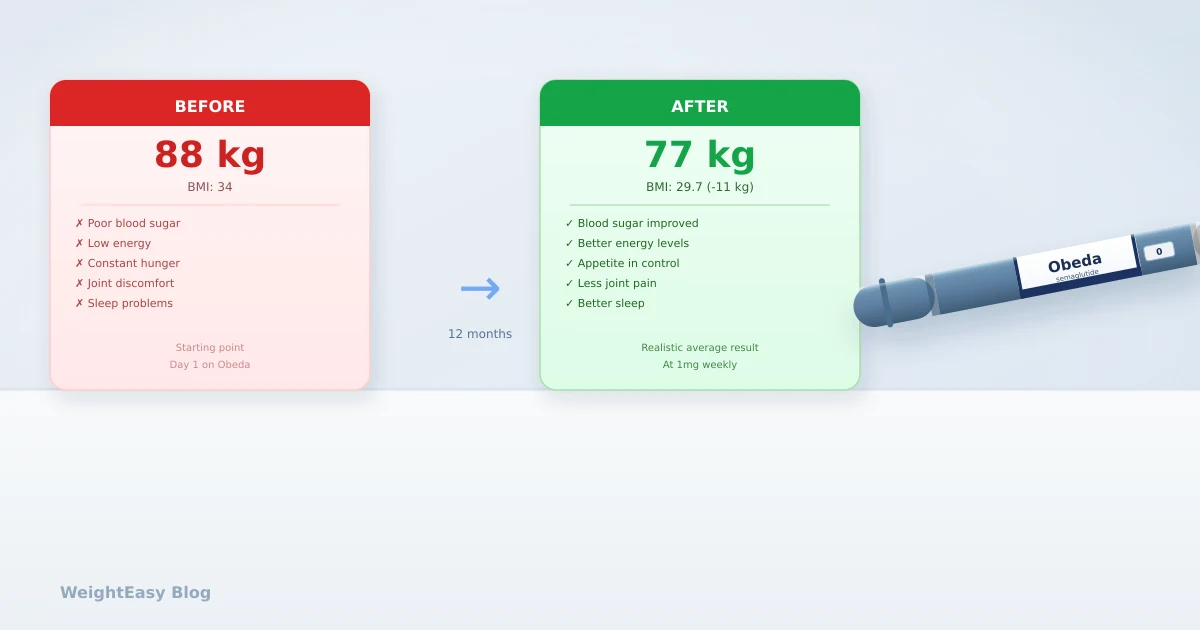
Social media feeds are full of dramatic semaglutide before-and-after photos. Before you start Obeda expecting the same, it is worth understanding what typical, realistic results actually look like -- based on clinical evidence rather than curated highlights.
This guide presents honest before-and-after outcomes for Indian patients starting Obeda in 2026.
Important: Always consult your healthcare provider before starting any medication. This article is for informational purposes only.
What "Before" Looks Like: Who Starts Obeda
A typical Obeda patient starting treatment in India might look like this:
Patient A: 42-year-old woman from Delhi. BMI 34. Weight: 88 kg. Height: 161 cm. Type 2 diabetes, HbA1c 8.2%. Has tried dieting multiple times. Was on metformin. Added Obeda.
Patient B: 38-year-old man from Bengaluru. BMI 31. Weight: 96 kg. Height: 176 cm. No diabetes but has high blood pressure and sleep apnoea. Trying Obeda for weight management.
Patient C: 50-year-old woman from Mumbai. BMI 30. Weight: 78 kg. Height: 161 cm. Post-menopausal, insulin-resistant, high cholesterol. Starting Obeda alongside dietary changes.
These are not extraordinary cases. They are the patients for whom Obeda is approved and clinically appropriate.
What "After 3 Months" Looks Like
At month 3, most patients have been on 0.5mg for 4-8 weeks. Here is what typically changes:
Numbers:
- Weight loss: 4-7% of starting weight (3.5-6 kg at 88 kg starting weight)
- Blood sugar: HbA1c down 0.5-1 percentage point in diabetic patients
- Blood pressure: Small reductions in many patients
Body:
- Clothes begin to feel looser, especially around the abdomen
- Face appears slightly slimmer
- Belt goes in one notch for most patients
How you feel:
- Significantly less hungry -- meals are smaller and more satisfying
- Nausea has mostly resolved
- Energy improving as blood sugar stabilises
- Often reporting a different, healthier relationship with food
What has NOT changed:
- No dramatic transformation visible yet
- You still have significant weight to lose
- You are not yet at your result -- this is early progress
What "After 6 Months" Looks Like
At 6 months, most patients have been at their maintenance dose for 3-4 months. This is where results become meaningful and visible.
Numbers at 6 months (based on STEP and SUSTAIN trial data):
- Average weight loss: 8-12% of starting weight
- At 88 kg starting weight: 7-10.5 kg lost
- HbA1c down 1-1.5 points in diabetic patients
- Systolic blood pressure down 5-8 mmHg on average
- Waist circumference reduced 6-10 cm on average
Body:
- Clearly visible change in body shape, especially abdominal fat
- Dropped 1-2 clothing sizes in many patients
- Noticeably slimmer face, neck, and upper body
How you feel:
- More energy for daily activities
- Improved sleep quality, especially if sleep apnoea was present
- Less joint discomfort
- Better mood and confidence in many patients
- Significantly improved relationship with food
What "After 12 Months" Looks Like
For patients who stay consistent for 12 months, this is where the full result of treatment becomes visible.
Numbers at 12 months:
- Average weight loss: 10-15% of starting weight
- At 88 kg: approximately 9-13 kg lost
- Substantial improvements in all metabolic markers
- Some diabetic patients reduce or eliminate oral medications (discuss with doctor)
Body:
- Two clothing sizes smaller for most patients in the 10-15% loss range
- Significant reduction in abdominal circumference
- Improved muscle-to-fat ratio if exercise has been part of the journey
Health changes:
- Meaningful cardiovascular risk reduction
- Improved insulin sensitivity
- Better energy and mobility
- For many patients: a genuinely transformed quality of life
Why Social Media Looks Different
Before-and-after photos online often show far more dramatic transformations. Here is why:
- Selection bias: People who post results are those with the most dramatic changes, not the average
- Longer timelines: Many viral posts represent 18-24 months of treatment, not 6 months
- Combined interventions: Many people also followed very strict diets and intense exercise programmes alongside the medication
- Higher doses: Some posts from outside India use the higher 2.4mg Wegovy dose, not the 1-2mg available in Obeda
- Photography: Before photos are often taken in unflattering angles, poor lighting, and after photos with optimal presentation
None of this means the medication does not work. It means the average result -- 8-12 kg over 12 months -- is real, significant, and health-transforming, even if it is not visually spectacular.
What Typically Stays the Same
To set complete expectations, here is what Obeda typically does NOT change dramatically:
- Loose skin: Rapid weight loss from any cause can increase loose skin. Obeda's gradual pace reduces this risk, but if you lose 12+ kg, some skin changes are likely
- Body shape genetics: Where you lose fat first is genetically determined. Obeda reduces overall fat but cannot spot-reduce
- Muscle mass: Without adequate protein and exercise, muscle loss accompanies fat loss. Protecting muscle requires both
Improving Your Own Before-and-After Story
The factors that move your results from average to better-than-average are well-established:
- High-protein diet -- preserves muscle and amplifies fat loss
- Consistent activity -- even walking 30 minutes daily makes a measurable difference
- Sleep quality -- poor sleep undermines weight loss even on semaglutide
- Stress management -- chronic stress raises cortisol, which resists fat loss
WeightEasy helps you address all of these systematically. With personalised diet guidance, habit coaching, side effect management, and progress tracking, WeightEasy helps you achieve results at the better end of the range -- not just the average.
If you are starting Obeda, the right support can make a significant difference. WeightEasy helps you stay consistent, manage side effects, and achieve better results.
The Bottom Line
Realistic Obeda before-and-after results after 12 months: 9-13 kg lost at 88 kg starting weight, significantly improved metabolic health, better energy, and a changed relationship with food.
This is not the dramatic transformation on your social media feed. It is a genuine, medically meaningful, life-improving change -- and for most patients with obesity or type 2 diabetes, it is exactly what they needed.
Consult your healthcare provider before starting any medication.
Sources
- STEP-1 trial: Wilding JPH et al. -- semaglutide 2.4mg, weight, waist, and metabolic outcomes (NEJM 2021)
- STEP-2 trial: Davies M et al. -- semaglutide in type 2 diabetes and obesity (Lancet 2021)
- SUSTAIN-6 trial: Marso SP et al. -- cardiovascular outcomes with semaglutide
- Rubino DM et al. -- effect of continued weekly subcutaneous semaglutide vs placebo on weight after stopping (NEJM 2021)
- WeightEasy clinical advisory team
FAQ
What do realistic Obeda before-and-after results look like?
After 6 months on Obeda at a maintenance dose of 0.5-1mg weekly, most patients lose 8-12% of starting body weight. At 90kg, that is 7-11 kg. Visible changes in body composition, clothing fit, and energy levels are common by months 3-4.
How visible are the changes after 3 months on Obeda?
Most people notice visible changes -- clothes fitting more loosely, a slightly slimmer face and abdomen -- from around month 3. The most dramatic visible changes typically occur between months 3-9.
Are the dramatic before-and-after photos on social media real?
Some are genuine results, but they typically represent the best-performing patients, not the average. Many also combine semaglutide with strict diets, personal training, and a longer timeframe than stated. Average results are meaningful but more modest.
What changes beyond weight loss can I expect?
Beyond the number on the scale, most patients report improved energy, better sleep, reduced joint pain, improved blood sugar (if diabetic), and a meaningfully different relationship with food and hunger.
Does everyone lose weight on Obeda?
No -- approximately 10-15% of patients are considered non-responders or low-responders. Most of these cases involve insufficient dose, poor dietary adherence, or underlying conditions affecting response. True non-response to semaglutide is relatively uncommon.