
Why Obeda May Not Work for You: 7 Honest Reasons
Not getting results on Obeda? Or thinking about starting? Here are 7 honest reasons why semaglutide may underperform -- and what you can do about it.
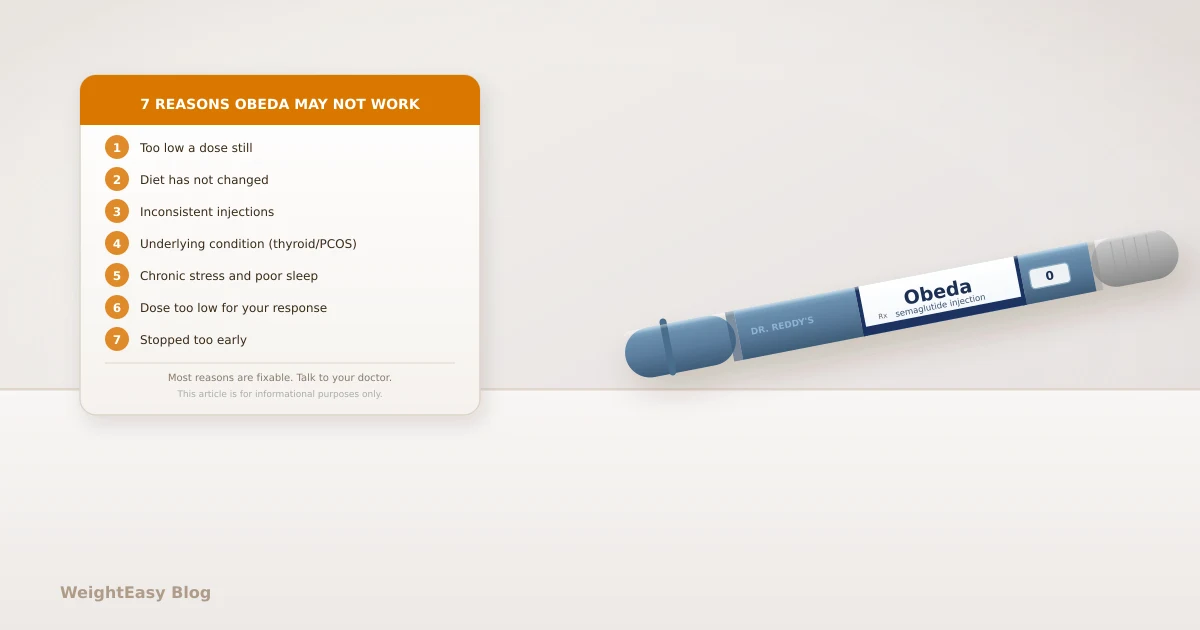
Obeda has strong clinical evidence behind it. But it does not work equally well for everyone. If you have started treatment and the results are disappointing -- or if you want to understand the risks before you begin -- this guide covers the most common reasons why semaglutide underperforms.
Most of these reasons are fixable. A few are not. Knowing the difference helps.
Important: Always consult your healthcare provider before starting any medication. This article is for informational purposes only.
Reason 1: You Are Still on the Starter Dose
The most common mistake people make is judging Obeda by its 0.25mg starter dose results.
The 0.25mg dose is not a therapeutic dose. It is a tolerance-building dose -- designed to help your body adjust to semaglutide without overwhelming side effects. Appetite suppression at this dose is mild. Weight loss in the first four weeks is typically minimal.
Significant results come at 0.5mg and 1mg. If you are two weeks in and not losing weight, you are not failing -- you are still in the adjustment phase.
What to do: Be patient. Follow the prescribed escalation schedule. Do not judge the medication until you have been at 0.5mg or 1mg for at least 8 weeks.
Reason 2: Your Diet Has Not Changed
Obeda dramatically reduces appetite. But it does not change what you eat when you do eat.
Many patients find they are eating smaller portions -- but those smaller portions are still predominantly refined carbohydrates, fried foods, and high-calorie snacks. Obeda cannot overcome poor food quality.
The evidence is clear: patients who combine semaglutide with a protein-rich, whole-food diet consistently outperform those who do not change their eating patterns. The medication reduces appetite; your food choices determine how much fat you actually lose.
What to do: Read what to eat while taking Obeda. Prioritise protein at every meal (dal, eggs, paneer, chicken, fish). Reduce refined carbohydrates and ultra-processed snacks. You do not need to starve -- just eat better.
Reason 3: You Are Not Taking It Consistently
Semaglutide's appetite suppression is cumulative. It builds over weeks. Missing even one or two weekly injections disrupts that steady-state effect and can set your progress back significantly.
Inconsistent use is common when people have side effects early on, travel, or run low on stock. Each gap in dosing means a partial restart of the adjustment process.
What to do: Set a recurring weekly alarm. Keep at least one pen in reserve. If nausea or other side effects are causing you to delay or skip injections, speak to your doctor about managing them rather than stopping the medication.
Reason 4: An Underlying Condition Is Working Against You
Several medical conditions make weight loss on semaglutide significantly harder:
- Hypothyroidism (underactive thyroid): A common condition in Indian women that slows metabolism. If untreated or undertreated, it can completely counteract the weight loss effect of Obeda.
- PCOS (polycystic ovary syndrome): Insulin resistance associated with PCOS makes fat loss harder, particularly around the abdomen.
- Sleep apnoea: Disrupted sleep raises cortisol and ghrelin (hunger hormone), counteracting semaglutide's appetite effect.
- Insulin resistance: Beyond what Obeda addresses, severe insulin resistance may require additional treatment.
What to do: Ensure your thyroid levels, fasting insulin, and other relevant markers are checked and managed before assuming Obeda is not working. Treating an underlying condition can unlock the weight loss that the medication alone was not achieving.
Reason 5: Chronic Stress and Poor Sleep
These are consistently underestimated by patients and sometimes by doctors too.
Chronic stress elevates cortisol, which promotes abdominal fat storage and can override semaglutide's appetite-suppressing effects. People under significant work, financial, or personal stress often see blunted results even on adequate doses.
Sleep deprivation raises ghrelin (hunger hormone) and lowers leptin (fullness hormone), directly counteracting what Obeda is trying to do. Poor sleep can make you feel hungrier than you should, even on the medication.
What to do: Sleep quality and stress management are not optional additions to your treatment plan -- they are core components. Aim for 7-8 hours of sleep. Identify and reduce major stressors. This is easier said than done, but it makes a measurable difference to outcomes.
Reason 6: Your Dose Is Too Low for Your Response Profile
Not everyone responds equally at the same dose. Some patients need 1mg to see meaningful results; others respond well at 0.5mg. A minority need 2mg.
If you have been at 0.5mg for 8 weeks and results have stalled, and you are tolerating the medication well, your doctor may consider titrating up to 1mg.
This is a clinical decision -- do not self-escalate without your doctor's guidance. But do not stay on an insufficient dose indefinitely if the medication is working in other ways (appetite reduction is present, but weight loss has plateaued).
What to do: Track your appetite changes and weight weekly. If appetite suppression is present but weight loss has stalled after 8 weeks, bring this data to your doctor for a dose review.
Reason 7: You Stopped Too Early
Semaglutide is a long-term treatment. The clinical trials that showed 14.9% weight loss ran for 68 weeks -- over 16 months. Many patients stop at 8-12 weeks when results feel slow, just before the medication reaches its full effect.
Early stopping is one of the biggest predictors of disappointing results on semaglutide. The medication builds its effect over time; abandoning it at month 2-3 means leaving most of the results on the table.
What to do: Commit to at least 6 months at your maintenance dose before evaluating whether the medication is working for you. Read the Obeda results timeline to understand what the realistic pace of progress looks like.
What to Do If None of These Apply
If you have addressed all seven of these factors and are still seeing minimal response after 16 weeks at 1mg, discuss true non-response with your doctor. Options include:
- Blood tests to rule out remaining underlying conditions
- A trial at 2mg (if not already there)
- Assessment for other contributing factors
- Discussion about alternative or additional treatments (such as tirzepatide)
True non-response to semaglutide is uncommon but real. It is not a failure -- it is information, and it opens the door to exploring better-suited options.
How WeightEasy Addresses These Root Causes
Most of the reasons Obeda underperforms are modifiable -- diet, consistency, side effect management, stress, sleep. WeightEasy's platform is designed to address precisely these factors systematically.
Personalised dietary guidance, weekly habit coaching, side effect tracking, and progress monitoring -- all structured to maximise your response to Obeda rather than leave results to chance.
If you are starting Obeda, the right support can make a significant difference. WeightEasy helps you stay consistent, manage side effects, and achieve better results.
The Bottom Line
Obeda works well for the majority of patients who use it correctly, consistently, and with appropriate dietary support. When it does not work as expected, one or more of these seven reasons is almost always present and addressable.
Do not give up before giving it a proper trial. Do not expect it to work without your participation. And if genuine non-response occurs, speak to your doctor about what comes next.
Consult your healthcare provider before starting any medication.
Sources
- STEP-1 trial: Wilding JPH et al. -- semaglutide responder analysis (NEJM 2021)
- Practical Diabetes -- patient characteristics predicting GLP-1 response
- Thyroid Foundation of India -- hypothyroidism prevalence and weight management
- Sleep Foundation -- sleep deprivation and weight regulation mechanisms
- WeightEasy clinical advisory team
FAQ
Why am I not losing weight on Obeda?
The most common reasons are: being on too low a dose still (first 4 weeks), not making dietary changes alongside the medication, not giving it enough time (at least 3 months needed), or an underlying condition like hypothyroidism or PCOS that needs separate management.
How long should I try Obeda before concluding it is not working?
At least 12 weeks at your maintenance dose (0.5mg or 1mg). Many people judge too early -- on the starter dose of 0.25mg, significant weight loss is not expected. Give the medication a proper trial at full dose before drawing conclusions.
Is it possible to be truly non-responsive to semaglutide?
True non-response (no weight loss despite correct dosing and good adherence) affects a small minority of patients -- estimated at 10-15%. Most apparent non-response has an identifiable cause. Discuss with your doctor if you have had no response after 16 weeks at 1mg.
Can stress cause Obeda to not work?
Yes. Chronic stress raises cortisol, which promotes fat storage especially around the abdomen and can counteract weight loss even on semaglutide. Stress management is not optional on this medication.
What should I do if Obeda is not working for me?
First, check the seven reasons in this article honestly. Then consult your doctor to review your dose, rule out underlying conditions, and discuss whether your dietary approach is appropriate. Do not stop without medical guidance.